
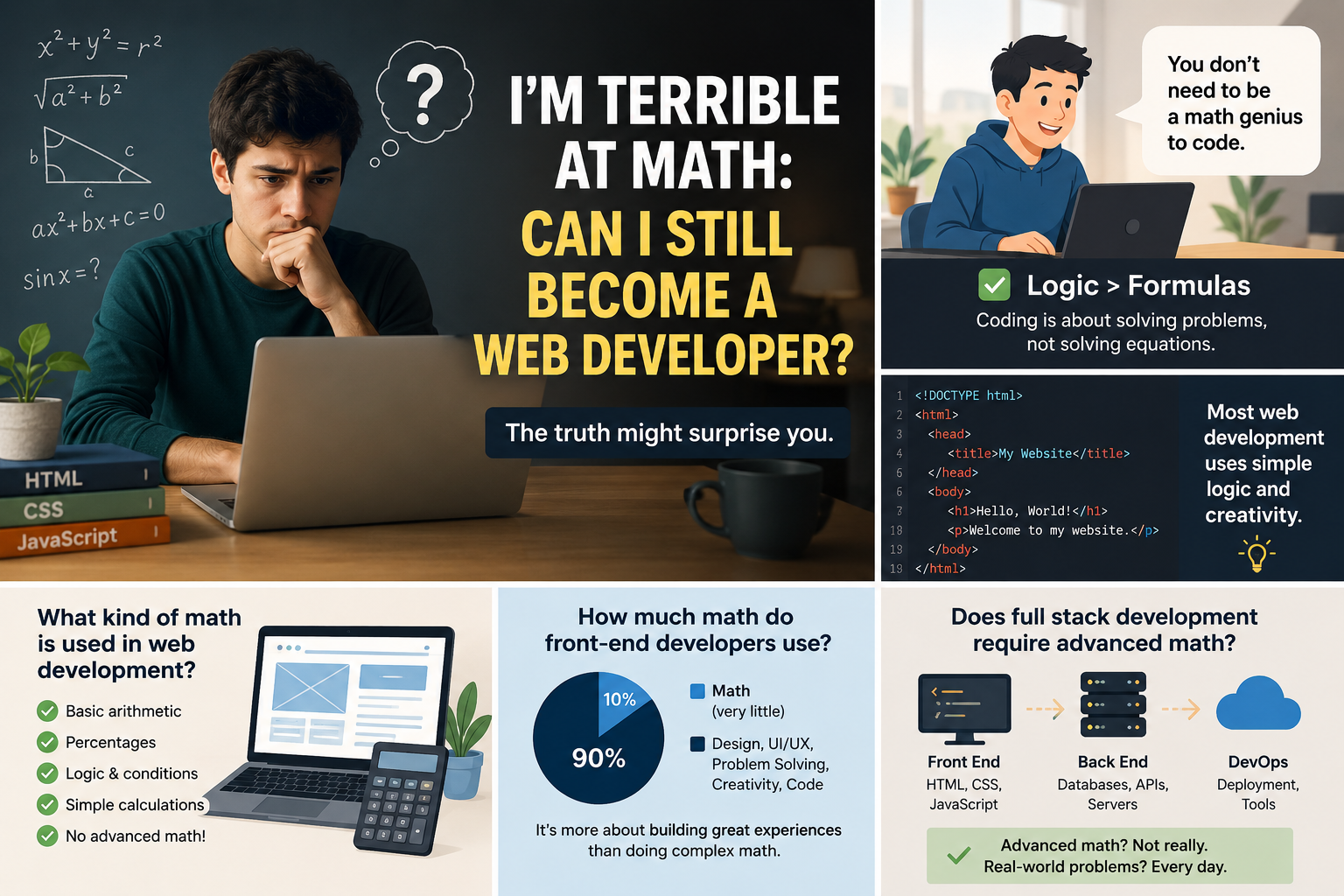
Yes, you can. In fact, many successful web developers started with the exact same fear.
If you’ve ever looked at a programming course and thought, “There’s no way I can do this—I was never good at math,” you’re not alone.
It’s one of the biggest myths in tech.
I’ve spoken with students, career changers, and self-taught developers who delayed learning to code for months—or even years—because they assumed web development required advanced mathematics. Many were surprised to discover that building websites is far more about solving problems than solving equations.
The truth is simple: being weak at math does not automatically make you bad at programming.
For most web development jobs, you’ll spend your time creating user interfaces, fixing bugs, organizing data, and building features that people use every day. Advanced calculus and complex formulas rarely enter the picture.
So if you’re wondering whether a dislike of math should stop you from becoming a developer, this guide will give you a realistic answer.
Table of Contents
- Why People Think Coding Requires Math
- Can You Learn Coding If You Hate Math?
- What Kind of Math Is Used in Web Development?
- How Much Math Do Front-End Developers Use?
- Does Full Stack Development Require Advanced Math?
- Skills That Matter More Than Math
- Common Mistakes Beginners Make
- A Practical Learning Roadmap
- Frequently Asked Questions
- Final Takeaway
Why People Think Coding Requires Math
The belief that programming requires exceptional math skills usually comes from three places:
- Movies that portray programmers as genius mathematicians
- Computer science degree programs that include advanced mathematics
- Confusion between software engineering and specialized technical fields
The problem is that people often lump all technology careers together.
A machine learning engineer, a game physics programmer, and a front-end web developer may all write code, but they use very different skill sets.
Imagine saying that every healthcare worker needs to perform surgery because surgeons do. That wouldn’t make sense.
The same logic applies to programming.
Some areas of software development rely heavily on mathematics. Most web development roles do not.
Can You Learn Coding If You Hate Math?
Absolutely.
If you’re asking yourself, “Can I learn coding if I hate math?”, the answer is yes.
In fact, many people who struggled in math classes find programming easier than expected because the two activities feel very different.
Math Often Focuses on Answers
In school, you’re usually expected to arrive at a correct solution using specific methods.
Programming works differently.
Programming Focuses on Building
As a developer, you’re creating something:
- A website
- A login system
- An online store
- A booking application
- A personal portfolio
Your goal isn’t to solve equations. Your goal is to make things work.
That’s why many people who disliked mathematics in school enjoy coding once they start building real projects.
A Real-World Example
Let’s say a local restaurant wants a website.
You might need to:
- Display the menu
- Create an online reservation form
- Show opening hours
- Add a contact page
- Connect a payment system
Notice what’s missing?
No calculus.
No trigonometry.
No advanced algebra.
Most of the work involves organizing information and creating a smooth experience for visitors.
What Kind of Math Is Used in Web Development?
The honest answer is that web developers use some math, but usually at a basic level.
Here’s what you’re most likely to encounter.
Basic Arithmetic
You’ll occasionally work with:
- Percentages
- Addition
- Subtraction
- Multiplication
- Division
For example:
An e-commerce store may offer a 25% discount on a ₹4,000 product.
Your application calculates the discounted price automatically.
That’s a common web development task.
Logical Thinking
This is where many beginners get confused.
People often call logical thinking “math,” but they’re not the same thing.
Consider this simple rule:
“If a user is logged in, show the dashboard. Otherwise, show the login page.”
That’s logic.
Most programming relies far more on logic than mathematics.
Simple Calculations
You might occasionally calculate:
- Screen sizes
- Element spacing
- Animation timing
- Pagination results
- Shopping cart totals
Even then, modern frameworks and libraries often handle much of the work for you.
When Advanced Math Becomes Important
There are programming fields where mathematics matters a lot.
These include:
- Artificial Intelligence
- Machine Learning
- Data Science
- Cryptography
- Scientific Computing
- Computer Graphics
- Physics Simulations
If your goal is to build websites, business applications, blogs, dashboards, or online stores, you can safely focus on coding skills first.
How Much Math Do Front-End Developers Use?
For most front-end developers, math is a very small part of the job.
Front-end development focuses on what users see and interact with.
Typical responsibilities include:
- Designing layouts
- Building navigation menus
- Creating forms
- Making websites mobile-friendly
- Improving accessibility
- Optimizing user experience
A normal workday may involve adjusting a button position, fixing a responsive layout issue, or improving page loading speed.
None of these tasks require advanced mathematics.
What Front-End Developers Actually Use Daily
Successful front-end developers rely more on:
- Attention to detail
- Creativity
- Problem-solving
- Design awareness
- Communication skills
When employers hire front-end developers, they usually care more about whether you can build a clean, functional interface than whether you remember high school algebra.
Does Full Stack Development Require Advanced Math?
Not usually.
Full stack developers work on both the front end and the back end of applications.
Their responsibilities often include:
Front End
- HTML
- CSS
- JavaScript
- React
- Vue
Back End
- Databases
- APIs
- Authentication
- Server logic
- Data processing
The challenging part isn’t mathematics.
The challenging part is understanding how all these systems connect together.
A Practical Example
Imagine you’re building an online pharmacy website.
You need to:
- Register users
- Store medicine information
- Manage inventory
- Process orders
- Track deliveries
The complexity comes from handling data correctly and ensuring everything works together smoothly.
The biggest challenge is system design—not advanced mathematics.
Skills That Matter More Than Math
After helping many beginners learn web development, I’ve noticed the same pattern.
The people who succeed aren’t necessarily the strongest at math.
They’re the ones who develop these skills.
Problem-Solving
Every coding challenge becomes easier when you learn to break it into smaller steps.
This skill is far more valuable than memorizing formulas.
Persistence
Even experienced developers get stuck.
The difference is that they keep experimenting until they find a solution.
Learning to stay patient during debugging is one of the most valuable abilities you can develop.
Curiosity
Technology changes constantly.
Developers who enjoy learning new tools and techniques tend to grow faster than those who rely solely on what they already know.
Reading Documentation
Professional developers spend a surprising amount of time reading official documentation.
Knowing how to find answers is often more important than already knowing them.
Communication
Software development is rarely a solo activity.
You’ll often work with:
- Designers
- Clients
- Managers
- Other developers
Strong communication skills can significantly improve your career opportunities.
Common Mistakes Beginners Make
Waiting Until They’re “Good Enough”
Many people spend months trying to learn every concept before building anything.
This slows progress.
Start creating projects early.
Comparing Themselves to Experts
You’re seeing professionals after years of experience.
Don’t compare your first month of learning to someone’s tenth year in the industry.
Assuming Every Developer Is a Math Genius
Most aren’t.
They’re simply people who practiced consistently and solved thousands of small problems over time.
Spending Too Much Time Watching Tutorials
Watching coding videos feels productive.
Building projects is what actually develops skill.
A simple portfolio website teaches more than ten hours of passive video watching.
A Practical Roadmap for Learning Web Development
If math anxiety has been holding you back, here’s a straightforward path.
Step 1: Learn HTML
Focus on structure and content.
Build simple pages first.
Step 2: Learn CSS
Practice layouts, typography, colors, and responsive design.
Step 3: Learn JavaScript
Start with:
- Variables
- Functions
- Loops
- Conditions
- Arrays
Master the basics before worrying about advanced topics.
Step 4: Build Small Projects
Create:
- A portfolio website
- A to-do list app
- A weather app
- A simple calculator
- A blog layout
Projects reveal what you truly understand.
Step 5: Learn a Framework
Popular choices include:
- React
- Vue
- Next.js
These tools are widely used in professional development.
Step 6: Create a Portfolio
A strong portfolio often carries more weight than grades or certificates.
Show employers what you can build.
Frequently Asked Questions
Can I become a web developer if I’m bad at math?
Yes. Most web development jobs require only basic arithmetic and logical thinking.
Can I learn coding if I hate math?
Absolutely. Many successful developers disliked math in school but excelled at programming because they enjoyed solving practical problems.
What kind of math is used in web development?
Web developers typically use basic arithmetic, percentages, and simple calculations rather than advanced mathematics.
How much math do front-end developers use?
Very little. Front-end development focuses more on design, user experience, accessibility, and interface development.
Does full stack development require advanced math?
In most cases, no. Full stack development is primarily about building and connecting systems, databases, and user interfaces.
Should I improve my math skills anyway?
Yes. Better math skills can improve your confidence and problem-solving ability. However, you don’t need to master advanced mathematics before learning to code.
Final Takeaway
Being bad at math is not a reason to give up on web development.
The vast majority of successful web developers spend their days building interfaces, solving practical problems, working with databases, and improving user experiences—not solving advanced equations.
What matters most is your willingness to learn, practice consistently, and keep building projects even when things feel confusing.
If you’ve been waiting until you’re “good enough” at math to start coding, stop waiting.
Open a browser, create your first HTML file, and begin.
A year from now, you’ll be glad you did.
Read about How to Fix the “secretOrPrivateKey Must Have a Value” Error in JWT (jsonwebtoken)