
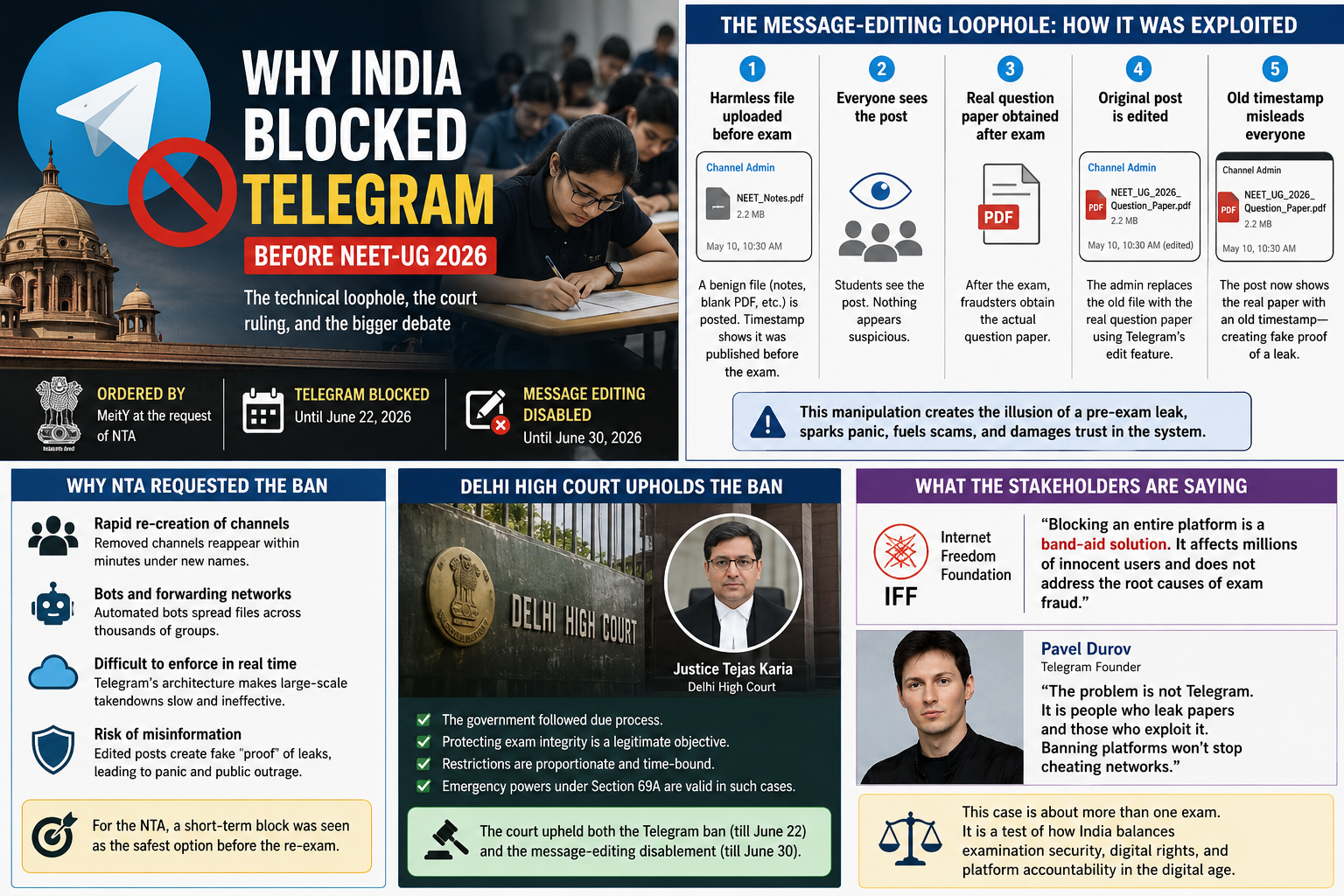
Why India Temporarily Blocked Telegram Before NEET-UG 2026: The Technical Loophole Behind the Controversy. Why India Temporarily Blocked Telegram Before NEET-UG 2026: The Technical Loophole Behind the Controversy A Messaging App, a Medical Entrance Exam, and a National Debate
Just days before the NEET-UG 2026 re-examination, the Indian government took an extraordinary step that immediately sparked debate across the technology, education, and civil liberties communities.
On the request of the National Testing Agency (NTA), the Ministry of Electronics and Information Technology (MeitY) ordered a temporary nationwide block of Telegram until June 22, 2026. The government also instructed the platform to disable its message-editing functionality for Indian users until June 30.
At first glance, the decision appeared to be another attempt to crack down on alleged exam-paper leaks. But officials argued that the real issue was more complex than leaked PDFs circulating online.
According to investigators, a little-known feature inside Telegram was allegedly being exploited to create fake evidence of question paper leaks, undermining public confidence in one of India’s most important competitive examinations.
The controversy has since evolved into something much larger than NEET itself. It has raised difficult questions about platform accountability, digital evidence manipulation, government powers during emergencies, and the future of internet regulation in India.
The Technical Problem Wasn’t the Leak. It Was the Timestamp.
Most discussions around exam fraud focus on one question:
Did someone obtain the paper before the exam?
Investigators examining suspicious Telegram channels reportedly encountered a different problem. In several cases, the challenge was determining whether the papers had actually been leaked beforehand or whether digital evidence had been manipulated afterward.
The key issue was Telegram’s message-editing capability.
Unlike many messaging platforms, Telegram allows channel administrators to edit previously published posts. This includes modifying attachments and files associated with those posts.
Authorities claim that some operators exploited this feature to create the illusion that they had access to examination papers before the test took place.
In other words, the controversy was not always about obtaining the paper early.
It was about making it appear that they had.
How the Alleged Telegram Loophole Worked
To understand the government’s concerns, it helps to see how the process allegedly unfolded.
Step 1: Publish an Innocent File Before the Exam
Days or hours before NEET, a Telegram channel would upload a harmless document.
Examples could include:
- Blank PDFs
- Old question papers
- Study notes
- Random educational material
The post would receive a legitimate timestamp showing it was published before the examination.
Step 2: Wait for the Examination to End
Nothing suspicious would appear to happen.
Students visiting the channel would simply see an ordinary file posted before exam day.
Step 3: Obtain the Actual Question Paper
After the examination concluded, fraudsters could gain access to the real question paper through various means.
At this point, the paper was no longer confidential because the exam had already taken place.
Step 4: Edit the Original Telegram Post
Instead of creating a new message, the administrator would allegedly edit the old post and replace the original attachment with the actual question paper.
The critical detail is that the post itself already carried an earlier timestamp.
Step 5: Present the Post as “Proof”
To an average user scrolling through the channel, it could appear as though the real question paper had been sitting on Telegram before the examination began.
Screenshots would then spread across social media.
Claims of a paper leak would go viral.
Trust in the examination process would suffer.
Whether a genuine leak had occurred became almost irrelevant because the edited post created what looked like convincing evidence.
For investigators, this represented a form of digital timeline manipulation rather than a traditional exam leak.
Why This Matters More Than Many People Realize
The consequences extend beyond a single examination.
Competitive exams in India involve millions of students and years of preparation.
Even an unverified rumor of a paper leak can have serious consequences:
- Students may panic.
- Parents lose confidence in the system.
- Coaching centers amplify speculation.
- Social media misinformation spreads rapidly.
- Authorities face pressure to cancel or reconduct exams.
A manipulated timestamp can therefore create real-world damage even if no actual leak occurred.
Several cybersecurity experts have pointed out that digital platforms increasingly influence how evidence is perceived. In an environment where screenshots often travel faster than fact-checks, even small platform design features can have unexpected consequences.
Why the NTA Requested an Emergency Intervention
According to officials, simply removing individual channels was proving ineffective.
Whenever one channel disappeared, similar groups allegedly reappeared under different names.
Authorities argued that Telegram’s infrastructure made rapid redistribution particularly easy through:
- Public channels with large audiences
- Massive group sizes
- Automated bots
- Forwarding networks
- Cloud-hosted file storage
- Quick channel recreation
From the NTA’s perspective, waiting until after the re-examination carried significant risk.
Officials reportedly concluded that a temporary intervention before the June 21 re-test was the safest way to prevent another wave of misinformation and fabricated leak claims.
The Government’s Two-Part Response
The government’s strategy focused on both immediate containment and feature-level restrictions.
1. Temporary Nationwide Telegram Block
The first measure was a short-term suspension of Telegram services across India until June 22, covering the period surrounding the NEET-UG re-examination.
Officials described this as an emergency step designed to protect the integrity of the examination process.
2. Disabling Message Editing Until June 30
The second measure attracted even more attention within technology circles.
Rather than targeting the entire platform, authorities specifically focused on the feature they believed was enabling the problem.
Telegram was directed to disable message editing for Indian users until June 30.
This is unusual because governments generally regulate platforms at the service level. Restricting a single platform feature is far less common and may signal a more targeted approach to future platform regulation.
Telegram’s Argument: Punishing Everyone for the Actions of a Few
Telegram challenged the government’s order before the Delhi High Court.
The company argued that it had already cooperated with authorities and removed channels reported for suspicious activity.
According to Telegram’s position, the government could have continued pursuing specific violators instead of imposing restrictions that affected millions of ordinary users who rely on the platform for communication, education, business, and community engagement.
The company maintained that targeted enforcement would have been a more proportionate response.
Delhi High Court Upholds the Ban
The legal challenge ultimately failed.
Justice Tejas Karia of the Delhi High Court dismissed Telegram’s petition and upheld the government’s decision.
The court concluded that the temporary restrictions were justified given the circumstances surrounding the NEET-UG re-examination.
In its reasoning, the court emphasized several factors:
- The limited duration of the restrictions
- The importance of protecting examination integrity
- The government’s stated security concerns
- The availability of legal powers under Section 69A of the Information Technology Act
The ruling effectively endorsed both the temporary platform block and the temporary suspension of Telegram’s editing functionality.
The judgment is likely to be studied closely because it may influence how future courts evaluate platform restrictions during time-sensitive national events.
Digital Rights Groups See a Different Problem
Not everyone agrees with the government’s approach.
Digital rights advocates argue that the restrictions address symptoms rather than causes.
The Internet Freedom Foundation (IFF) described the move as a “band-aid solution,” arguing that blocking an entire platform does little to solve the deeper issues surrounding examination security and information leaks.
Critics raise several concerns:
- Millions of legitimate users were affected.
- Alternative platforms remain available.
- Bad actors can migrate elsewhere.
- Platform-wide restrictions may set concerning precedents.
For civil liberties groups, the broader question is whether governments should block an entire communication platform because of misuse by a relatively small number of users.
Pavel Durov’s Response
Telegram founder Pavel Durov also criticized the decision.
Durov reportedly argued that technology platforms should not be blamed for the actions of individuals abusing them.
He suggested that fraud networks tend to migrate quickly between services and that platform bans rarely eliminate underlying criminal activity.
His comments reflect a long-standing debate within the technology industry: should platforms be held responsible for misuse of their tools, or should enforcement focus exclusively on the individuals committing wrongdoing?
There is no simple answer, and the Telegram controversy has brought that debate back into the spotlight.
A Defining Test for India’s Digital Governance
The temporary Telegram block may last only a few days, but its significance could extend far beyond the NEET-UG re-examination.
For students, the issue is about ensuring a fair examination process.
For technology companies, it highlights how platform features can create unforeseen vulnerabilities.
For policymakers, it offers a new model for responding to digital misinformation and evidence manipulation.
And for citizens, it raises a fundamental question:
When online tools can be used to manufacture convincing but misleading evidence, where should governments draw the line between protecting public trust and preserving digital freedoms?
The answer will shape not only future examinations but also the broader relationship between technology platforms, regulators, and users in the years ahead.