
A few years ago, AI coding tools were mostly glorified autocomplete systems.
They could suggest the next line of code, generate simple functions, or help developers write documentation faster. Useful? Absolutely. Revolutionary? Not quite.
Fast forward to 2026, and the conversation has changed dramatically.
Today’s most advanced AI systems can analyze requirements, create development plans, write production-ready code, run tests, fix bugs, and even deploy applications. Instead of helping developers write code, they’re beginning to handle entire chunks of the software development process on their own.
That’s why many technology leaders believe we’re entering the era of the Autonomous AI Software Engineer.
This doesn’t mean human developers are disappearing. In fact, experienced engineers are becoming more important than ever. What’s changing is how software gets built—and how much of the routine work can now be delegated to intelligent systems.
Let’s explore why 2026 has become a turning point for AI-powered software development and what it means for developers, businesses, and the future of technology.
Table of Contents
- What Is an Autonomous AI Software Engineer?
- Understanding Agentic AI in Software Development
- What Is Intent-Based Code Generation?
- AI Agents vs AI Copilots for Coding
- Why 2026 Is Different
- Multi-Agent Coding Workflows Explained
- Real-World Applications Already Emerging
- Benefits and Challenges
- How Developers Can Prepare
- The Future of AI Code Generation
- Frequently Asked Questions
- Final Takeaway
What Is an Autonomous AI Software Engineer?
An autonomous AI software engineer is an AI system capable of completing software development tasks with minimal human intervention.
Unlike traditional coding assistants that wait for instructions at every step, autonomous systems can work toward a broader goal.
For example, imagine a startup founder who needs a customer support dashboard.
A traditional coding assistant might help generate pieces of code when requested.
An autonomous system can:
- Analyze requirements
- Design a suitable architecture
- Build the user interface
- Create database models
- Write automated tests
- Identify and fix bugs
- Generate documentation
The human sets the destination. The AI handles much of the journey.
This shift is what makes current AI advancements fundamentally different from previous generations of development tools.

Understanding Agentic AI in Software Development
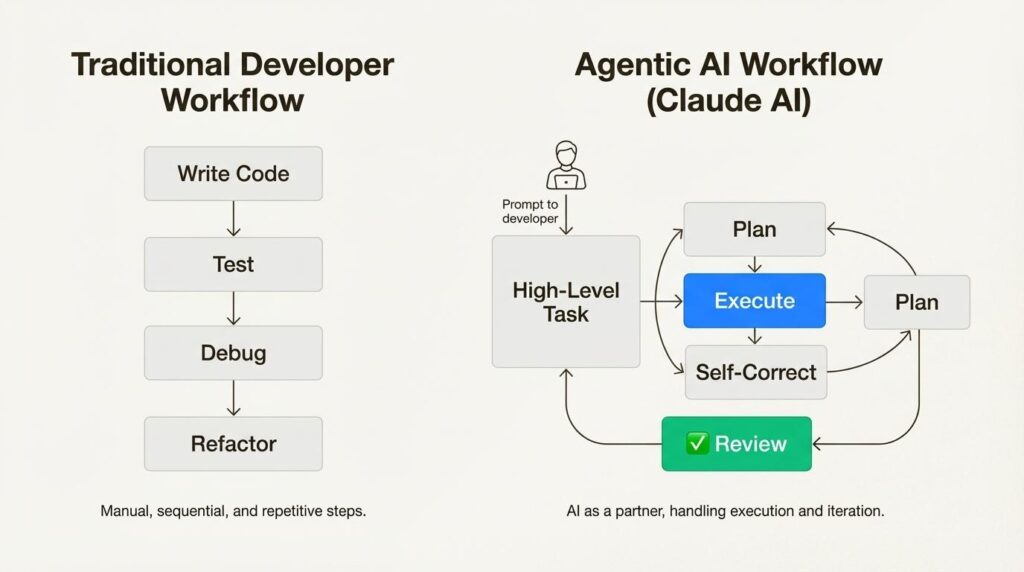
One of the most important concepts behind this shift is Agentic AI in software development.
An AI agent isn’t simply responding to prompts. It is actively pursuing an objective.
Think of the difference between a calculator and a project manager.
A calculator performs a task when instructed.
A project manager receives a goal and determines the steps required to achieve it.
Modern AI agents operate much closer to the second model.
For example, a development manager might provide a simple instruction:
“Build an internal reporting tool that allows department heads to monitor monthly performance metrics.”
An agentic system can break the request into smaller tasks, create a plan, write code, run tests, identify issues, and continue improving the project until the objective is achieved.
The developer remains responsible for oversight and validation, but much of the execution becomes automated.
What Is Intent-Based Code Generation?
One of the biggest changes driving software development in 2026 is the move toward intent-based software engineering.
Understanding the Concept
Many developers still think in terms of writing code line by line.
AI systems are changing that mindset.
Instead of describing how to build something, developers increasingly describe what they want to achieve.
For example, rather than manually creating database queries, API endpoints, user interfaces, and validation rules, a developer might simply request:
“Create a secure customer portal where users can view invoices, update account information, and download payment receipts.”
The AI interprets the intent and generates the technical implementation.
This approach dramatically reduces time spent on repetitive engineering work.
Why It Matters
Intent-based code generation allows developers to focus on:
- Business requirements
- User experience
- Architecture decisions
- Product strategy
Rather than spending hours building routine components, engineers can dedicate more attention to solving meaningful problems.
AI Agents vs AI Copilots for Coding
A common misconception is that AI agents and AI copilots are the same thing.
They aren’t.
Understanding the distinction helps explain why autonomous development is advancing so quickly.
AI Copilots
AI copilots act as assistants.
They help developers by:
- Suggesting code
- Explaining functions
- Creating documentation
- Identifying potential bugs
The developer remains in control of every major decision.
AI Agents
AI agents go much further.
They can:
- Execute workflows
- Manage development tasks
- Run testing pipelines
- Fix issues automatically
- Interact with development tools
- Deploy applications
Quick Comparison
| Capability | AI Copilot | AI Agent |
|---|---|---|
| Code Suggestions | Yes | Yes |
| Autonomous Planning | No | Yes |
| Execute Tasks | Limited | Extensive |
| Automated Testing | Limited | Yes |
| Deployment Actions | Rare | Yes |
| Independent Workflow Management | No | Yes |
Many organizations are now using both approaches together.
Copilots enhance productivity while agents handle increasingly complex workflows.
Why 2026 Is Different
Every major technology trend has a tipping point.
For autonomous software engineering, 2026 appears to be that moment.
Several developments have converged at the same time.
AI Models Understand Larger Systems
Earlier models worked best on individual functions or small code snippets.
Modern systems can understand entire applications, making them significantly better at maintaining consistency across large projects.
Better Tool Integration
Today’s AI systems aren’t isolated chatbots.
They can interact directly with:
- Source control platforms
- Development environments
- Testing frameworks
- Cloud infrastructure
- Monitoring tools
This enables end-to-end workflow automation.
Increased Enterprise Adoption
Many businesses have moved beyond experimentation.
AI-assisted development is becoming a standard part of software teams rather than an optional productivity enhancement.
The result is greater investment, faster innovation, and more capable systems.
Multi-Agent Coding Workflows Explained
One of the most interesting trends emerging in 2026 is the rise of multi-agent coding workflows.
Instead of relying on a single AI system, organizations deploy multiple specialized agents working together.
This mirrors how human engineering teams operate.
Example Workflow
Requirements Agent
Analyzes business needs and creates specifications.
Architecture Agent
Designs system structure and technology choices.
Development Agent
Generates application code.
Quality Assurance Agent
Runs tests and identifies problems.
Documentation Agent
Creates user guides and technical documentation.
Each agent focuses on a specific responsibility, improving both efficiency and quality.
This team-based AI approach is becoming increasingly common in larger development environments.
Real-World Applications Already Emerging
Autonomous development is no longer a future prediction.
It’s already happening.
Internal Business Tools
Organizations are rapidly generating dashboards, reporting systems, and workflow automation tools that once required months of engineering effort.
Legacy System Modernization
Many companies still rely on aging software built years ago.
AI systems are helping teams understand, refactor, and modernize these applications much faster than traditional methods.
Automated Testing
Quality assurance has historically consumed a significant amount of developer time.
AI agents can now generate, execute, and maintain test suites with minimal supervision.
Startup Product Development
Small startup teams can move from idea to prototype remarkably quickly.
A founder with a clear product vision can often validate concepts in days rather than weeks.
Benefits and Challenges
Like every major technological shift, autonomous software engineering creates both opportunities and risks.
Benefits
Faster Delivery
Projects move from concept to implementation much more quickly.
Greater Productivity
Developers spend less time on repetitive tasks and more time solving business problems.
Better Documentation
AI systems can continuously update documentation alongside code changes.
Increased Accessibility
Smaller teams can build products that previously required larger engineering departments.
Challenges
Human Oversight Remains Essential
AI-generated code still requires review.
A fast mistake is still a mistake.
Security Considerations
Organizations must carefully validate generated code for vulnerabilities and compliance requirements.
Business Context Is Difficult
AI may understand technical requirements while missing important organizational or customer-specific nuances.
Skill Erosion Risks
Developers who rely entirely on automation may struggle to maintain core engineering expertise.
The most successful teams treat AI as a powerful collaborator rather than a replacement for human judgment.
How Developers Can Prepare
Developers don’t need to compete with AI.
They need to learn how to direct it effectively.
Strengthen System Design Skills
Architecture and high-level decision-making are becoming increasingly valuable.
Learn AI-Oriented Workflows
Understanding how to guide, review, and manage AI systems will become a core professional skill.
Focus on Product Thinking
Businesses don’t pay for code.
They pay for solutions.
Developers who understand customer needs will remain highly valuable.
Improve Communication Skills
Clear requirements produce better AI outcomes.
The ability to define goals precisely may become just as important as writing code.
The Future of AI Code Generation
The future isn’t about AI replacing developers.
It’s about expanding what developers can accomplish.
Over the next several years, we’ll likely see:
- Autonomous bug-fixing systems
- Self-improving testing pipelines
- AI-generated architecture recommendations
- Smarter deployment automation
- More specialized development agents
Software engineering is evolving from a craft centered on writing code to a discipline focused on defining objectives, validating outcomes, and orchestrating intelligent systems.
The keyboard isn’t disappearing.
But the way we use it is changing.
Frequently Asked Questions
Will AI replace software engineers?
No. Software engineering involves business understanding, architecture decisions, communication, creativity, and accountability. AI can automate portions of development, but human expertise remains critical.
What is intent-based code generation?
Intent-based code generation allows developers to describe desired outcomes while AI handles much of the implementation process.
What is Agentic AI in software development?
Agentic AI refers to AI systems capable of planning, executing, and adapting actions to achieve software development goals with limited human intervention.
What are multi-agent coding workflows?
These workflows involve multiple specialized AI agents collaborating on planning, coding, testing, deployment, and documentation tasks.
What skills will matter most in the AI era?
System design, product thinking, problem-solving, communication, security awareness, and AI workflow management are becoming increasingly valuable.
Final Takeaway
2026 may be remembered as the year software development entered a new phase.
The combination of agentic AI, intent-based software engineering, and multi-agent workflows is transforming how applications are designed, built, and maintained.
The most successful developers won’t necessarily be the ones who write the most code.
They’ll be the ones who understand problems deeply, communicate goals clearly, and know how to leverage AI systems effectively.
The future of software engineering isn’t human versus AI.
It’s human expertise amplified by AI capability.