
Learn how to grow healthy new money plants from simple stem cuttings, avoid common propagation mistakes, and enjoy a thriving collection of indoor greenery.
Introduction
Few houseplants are as forgiving—or as easy to multiply—as the money plant.
If you’ve ever admired a long trailing vine and wished you had more of them around your home, the good news is that you don’t need to buy another plant. A single healthy stem can produce several new plants with nothing more than a glass of water and a little patience.
I’ve propagated dozens of money plants over the years, and the process is surprisingly reliable once you understand one crucial detail: roots grow from nodes, not leaves.
That’s where most beginners go wrong.
In this guide, you’ll learn exactly where to cut a money plant for propagation, how long roots take to develop, whether water or soil propagation works better, and what to do if your cuttings start rotting before they root.
Whether you’re growing your first houseplant or expanding an indoor jungle, this step-by-step method is one of the easiest ways to create healthy new plants for free.
Table of Contents
- What Is Money Plant Propagation?
- Why Water Propagation Works So Well
- Supplies You’ll Need
- Where to Cut Money Plant for Propagation Nodes
- Step-by-Step Guide to Propagating a Money Plant in Water
- How Long Do Money Plant Roots Take to Grow in Water?
- Can You Propagate a Money Plant from a Single Leaf?
- Money Plant Propagation in Water vs Soil
- Common Problems and How to Fix Them
- Why Are My Money Plant Cuttings Rotting in Water?
- Expert Tips for Faster Success
- Frequently Asked Questions
- Final Takeaway
What Is Money Plant Propagation?
Propagation is simply the process of creating a new plant from an existing one.
Instead of starting from seeds, you use a portion of a mature plant—usually a stem cutting—to grow roots and eventually develop a completely independent plant.
Money plants are particularly well-suited for propagation because they naturally produce growth points along their vines. Under the right conditions, these growth points quickly develop roots.
This is one reason money plants have become a favorite among beginner gardeners and houseplant enthusiasts alike.
Why Water Propagation Works So Well
Many plants can be propagated in water, but money plants seem especially adapted to it.
The biggest advantage is visibility.
Unlike soil propagation, where root development happens out of sight, water allows you to monitor progress day by day. You can immediately tell whether a cutting is thriving, stalled, or developing problems.
Water propagation is also:
- Beginner-friendly
- Low-cost
- Clean and mess-free
- Great for small spaces
- Visually attractive on shelves and windowsills
A simple glass jar filled with healthy cuttings often becomes part of the room’s decor.
Supplies You’ll Need
Before taking your first cutting, gather the following:
- Clean, sharp scissors or pruning shears
- A healthy money plant
- A glass jar, vase, or bottle
- Fresh water
- A bright location with indirect sunlight
That’s it.
No rooting hormone, special fertilizer, or expensive equipment is necessary.
Where to Cut Money Plant for Propagation Nodes
If there’s one section you shouldn’t skip, it’s this one.
Most failed propagation attempts happen because the cutting doesn’t contain a node.
What Is a Node?
A node is the small joint on a stem where new growth originates.
It’s usually located where:
- A leaf connects to the vine
- A new shoot emerges
- Tiny aerial roots appear
Think of the node as the plant’s growth center. Without it, new roots cannot develop.
How to Identify a Node
Look closely along a healthy vine.
You’ll typically notice a slight bump or thicker section just below each leaf. Some money plants also produce tiny brown aerial roots at these points.
That’s your node.
The Correct Place to Cut
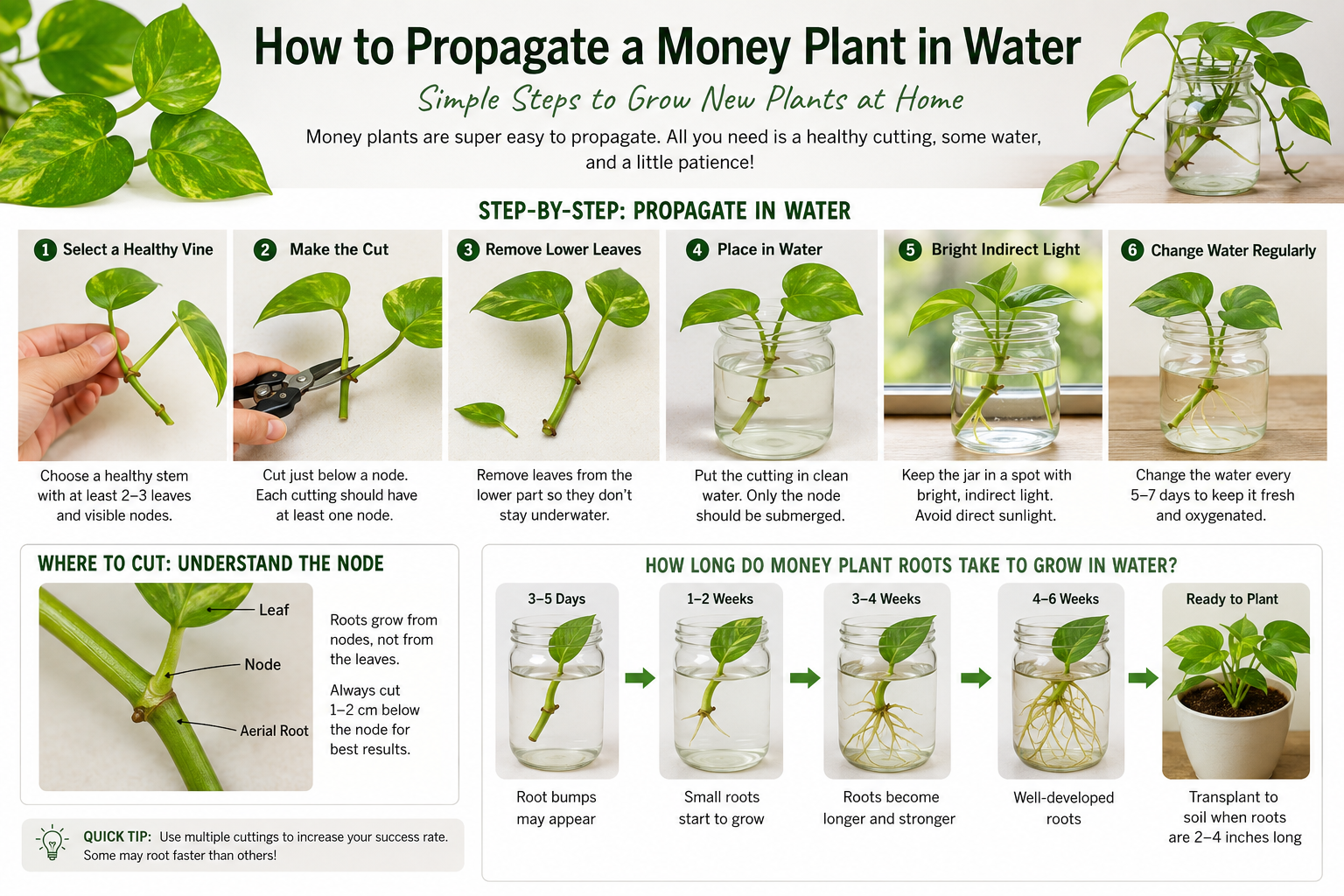
Cut approximately 1–2 cm below the node.
A good propagation cutting should include:
- At least one node
- One to three healthy leaves
- A healthy section of stem
Longer cuttings generally establish themselves faster because they contain more energy reserves.
Step-by-Step Guide to Propagating a Money Plant in Water
Step 1: Choose a Healthy Stem
Select a vine with vibrant green leaves and active growth.
Avoid stems that are:
- Yellowing
- Damaged
- Diseased
- Extremely thin or weak
Healthy parent plants produce stronger cuttings.
Step 2: Make a Clean Cut
Using sterilized scissors, cut just below a node.
If the cutting has leaves near the bottom, remove them so they won’t sit underwater.
This simple step helps prevent rot later.
Illustration: Identifying and Cutting Below a Node
Step 3: Place the Cutting in Water
Fill a glass container with fresh water.
Position the cutting so:
- The node remains submerged
- The leaves stay above the water line
Only the node needs to be underwater.
Step 4: Provide Bright Indirect Light
Place the container near a bright window where it receives filtered light.
A common beginner mistake is placing cuttings in direct afternoon sun. Excessive heat can stress the cutting and encourage algae growth.
Step 5: Change the Water Weekly
Replace the water every 5–7 days.
Fresh water provides oxygen and discourages bacterial buildup.
This small habit significantly improves rooting success.
Illustration: Water Propagation Setup
Step 6: Wait for Roots to Develop
This is the easiest step—and often the hardest emotionally.
Resist the urge to constantly move or inspect the cutting.
Stable conditions usually produce the best results.
How Long Do Money Plant Roots Take to Grow in Water?
One of the most frequently asked questions is:
How long do money plant roots take to grow in water?
The answer depends on temperature, light, and the health of the cutting.
Under typical indoor conditions:
| Growth Stage | Average Time |
|---|---|
| Root buds appear | 5–10 days |
| Visible roots emerge | 1–3 weeks |
| Strong root system forms | 4–6 weeks |
| Ready for potting in soil | 4–8 weeks |
During warm months, many cuttings produce roots surprisingly quickly.
I’ve often seen healthy summer cuttings develop visible roots within ten days, while winter cuttings may take twice as long.
Can You Propagate a Money Plant from a Single Leaf?
This is one of the biggest misconceptions surrounding money plant propagation.
Many people search for how to propagate money plant from a single leaf, hoping a detached leaf will grow into a full plant.
In most cases, it won’t.
Why a Single Leaf Doesn’t Work
A detached leaf may stay green for weeks or even months, but without a node, it lacks the growth tissue needed to produce a new vine.
The leaf can survive temporarily, but it cannot become a complete plant.
What Actually Works?
A successful “single-leaf propagation” must include:
- One healthy leaf
- One node
- A small piece of stem
That tiny node makes all the difference.
Money Plant Propagation in Water vs Soil
Both methods can produce excellent results.
The best choice depends on your experience level and preferences.
Water Propagation
Advantages
- Easy to monitor progress
- Great for beginners
- Lower risk of underwatering
- Decorative appearance
Disadvantages
- Requires water changes
- Water roots must adapt after transplanting
Soil Propagation
Advantages
- Roots adapt directly to soil
- Less transplant shock
- Faster long-term establishment
Disadvantages
- Harder to monitor progress
- Easier to overwater
Which Method Should You Choose?
For most beginners, water propagation is the better starting point.
Being able to see roots develop removes much of the guesswork and makes the process more enjoyable.
Common Problems and How to Fix Them
Even easy plants occasionally run into trouble.
Here are the issues I see most often.
Yellow Leaves
Possible causes:
- Old water
- Insufficient light
- Natural aging of lower leaves
Solution: Refresh the water and move the cutting closer to bright indirect light.
No Roots After Several Weeks
Possible causes:
- Missing node
- Low temperatures
- Weak cutting
Solution: Double-check that the cutting contains a node and move it to a warmer location.
Slimy Stem
This usually signals bacterial growth.
Solution: Trim away affected tissue, clean the container thoroughly, and replace the water.
Why Are My Money Plant Cuttings Rotting in Water?
If your cutting turns black, mushy, or develops a foul smell, rot is likely the culprit.
Fortunately, the causes are usually easy to identify.
Leaves Are Sitting Underwater
Submerged leaves decompose quickly and encourage bacteria.
Fix: Remove any leaves below the water line.
Water Isn’t Being Changed Often Enough
Stagnant water creates ideal conditions for harmful microorganisms.
Fix: Replace water every week.
The Container Is Overcrowded
Too many cuttings in a small jar reduce oxygen circulation.
Fix: Give each cutting adequate space.
The Original Cutting Was Unhealthy
Weak or diseased stems struggle to root successfully.
Fix: Always take cuttings from vigorous vines.
Temperatures Are Too Low
Cold conditions slow root formation and increase the likelihood of decay.
Fix: Keep cuttings between 18°C and 30°C (65°F–86°F).
Expert Tips for Faster Success
After propagating many money plants, a few patterns consistently stand out.
Use Multiple Nodes
Cuttings with two or three nodes usually root faster than single-node cuttings.
Prioritize Light Over Fertilizer
Most rooting problems are caused by insufficient light rather than lack of nutrients.
Don’t Rush Transplanting
Allow roots to become well-established before moving cuttings into soil.
Start Several Cuttings at Once
Professional growers rarely propagate a single cutting.
Taking multiple cuttings increases the chances of success and creates a fuller plant later.
Be Patient
Healthy roots take time.
The gardeners who succeed most often are usually the ones who interfere the least.
Frequently Asked Questions
Can a money plant live permanently in water?
Yes. Many people grow money plants in water for years by replacing the water regularly and occasionally supplying nutrients.
Do I need rooting hormone?
No. Money plants root readily without rooting hormone.
Can I propagate a money plant without a node?
No. Nodes are essential because new roots emerge from them.
When should I transfer rooted cuttings to soil?
When roots are approximately 2–4 inches (5–10 cm) long, they are usually ready for transplanting.
Why is my cutting growing roots but not new leaves?
This is completely normal. Most cuttings focus on establishing roots before producing new foliage.
Final Takeaway
Money plant propagation is one of the simplest and most rewarding skills a houseplant owner can learn.
The process doesn’t require special tools, expensive products, or advanced gardening knowledge. What it does require is understanding where roots come from and giving the cutting enough time to develop.
Remember the essentials:
- Always include at least one node
- Keep leaves above the water line
- Change water every week
- Provide bright indirect light
- Be patient during the rooting phase
Follow those five rules, and you’ll be surprised how quickly one healthy money plant can turn into several thriving new plants.