
El Niño and the Monsoon in 2026: How It Could Affect Agriculture, Food Prices, and Everyday Life
When weather experts mention El Niño, the discussion quickly moves beyond meteorology. For millions of farmers, food businesses, policymakers, and consumers, it raises a practical question:
Will this year’s monsoon be strong enough to support crops and keep food prices stable?
India’s agriculture remains closely tied to the Southwest Monsoon. Even with expanding irrigation networks, a large share of farmland still depends on seasonal rainfall. When rainfall patterns change, the effects can ripple through the economy—from crop production and rural incomes to grocery bills in cities.
As attention turns toward the El Nino monsoon impact 2026, understanding the connection between climate patterns, agriculture, and food inflation becomes increasingly important.
This guide explains what El Niño is, why it matters for India’s monsoon, how it can affect farmers, and what consumers should realistically expect.
Table of Contents
- What Is El Niño?
- Why Does El Niño Affect India?
- Why the Southwest Monsoon Matters So Much
- How El Niño Impacts Agriculture
- Which Crops Face the Greatest Risk?
- The Link Between El Niño and Food Prices
- Lessons From Past El Niño Years
- How Farmers Can Prepare
- What Consumers Should Watch in 2026
- Frequently Asked Questions
- Final Thoughts
What Is El Niño?
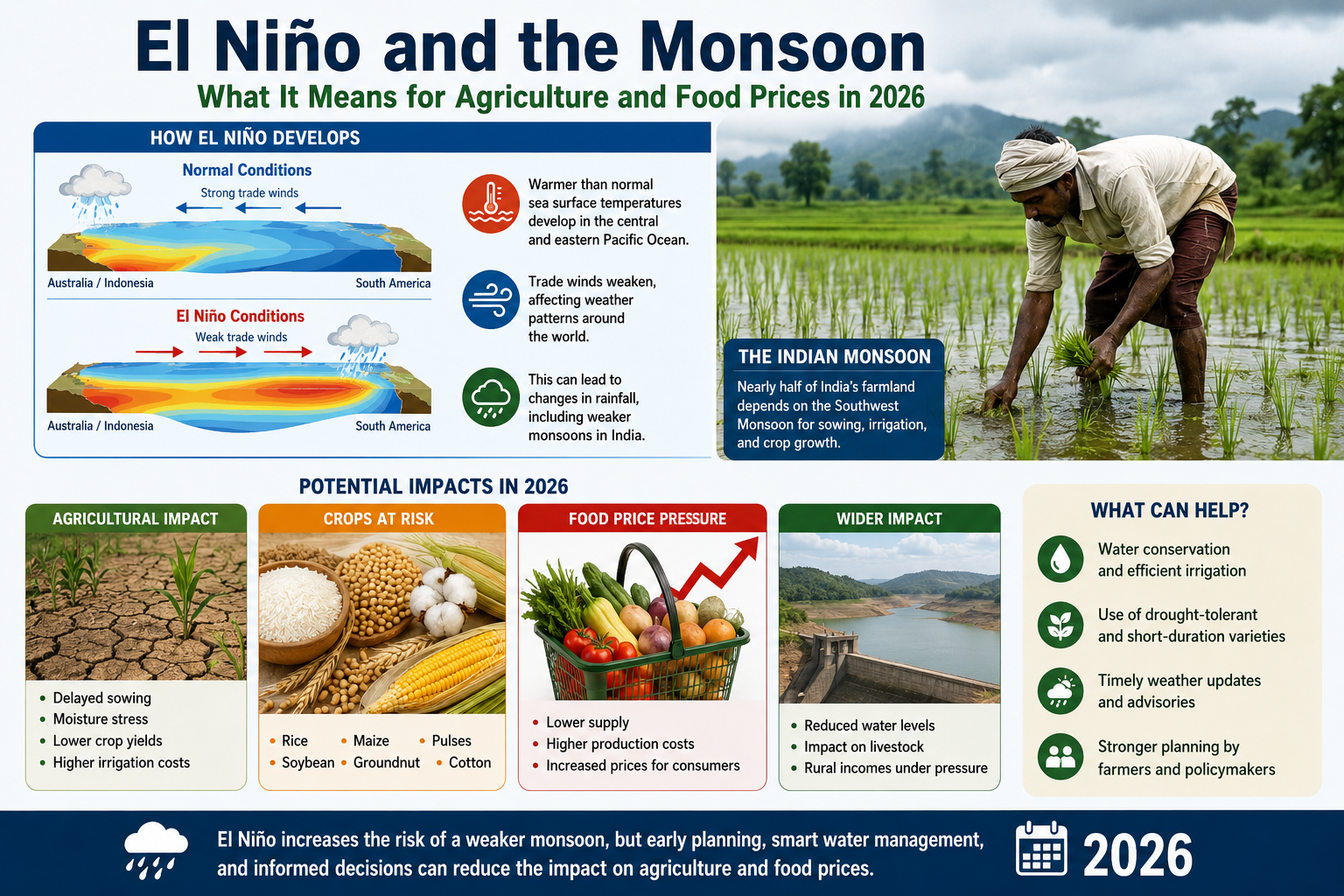
El Niño is a naturally occurring climate pattern that develops when sea surface temperatures in parts of the Pacific Ocean become warmer than average.
At first glance, a change in ocean temperatures thousands of kilometers away may not seem relevant to India. Yet the atmosphere is interconnected. Changes in Pacific Ocean temperatures can influence wind patterns, rainfall distribution, and weather systems across the globe.
Think of it as a disturbance in one part of a giant weather network. The effects often spread far beyond where the warming begins.
Historically, many El Niño events have been associated with weaker-than-normal monsoon rainfall in India, although the relationship is not always predictable.
Why Does El Niño Affect India?
The Indian monsoon is driven by complex interactions between land temperatures, ocean temperatures, air pressure systems, and seasonal winds.
Under normal conditions:
- The Indian landmass heats up during summer.
- Warm air rises over the subcontinent.
- Moisture-laden winds move inland from the ocean.
- Widespread rainfall develops across much of the country.
During an El Niño event, these atmospheric processes can weaken or shift.
The result may include:
- Below-normal rainfall
- Uneven rain distribution
- Longer dry spells
- Delayed monsoon onset in some regions
A delayed monsoon is often more damaging than many people realize. Farmers frequently schedule land preparation, sowing, fertilizer application, and labor arrangements around expected rainfall dates.
When rains arrive late, the entire agricultural calendar can be disrupted.
Why the Southwest Monsoon Matters Beyond Farming
When people hear “monsoon,” they often think only about agriculture.
In reality, the Southwest Monsoon influences much more.
Monsoon rainfall helps:
- Recharge groundwater reserves
- Refill reservoirs and dams
- Support hydropower generation
- Supply drinking water
- Sustain livestock
- Support rural employment
A weak monsoon can therefore affect multiple sectors simultaneously.
This is one reason economists, commodity traders, and government agencies monitor monsoon forecasts almost as closely as farmers do.
How the El Niño Effect on Agriculture Works
The El Nino effect on agriculture is rarely caused by a single weather event. Instead, it develops through a chain of interconnected challenges.
Reduced Soil Moisture
Crops need adequate moisture during germination and early growth stages.
When rainfall is lower than expected, soil dries faster, making it harder for seeds to establish healthy roots.
A farmer may sow on time, but if the expected follow-up rains do not arrive, young plants can experience significant stress.
Higher Irrigation Costs
Farmers with irrigation systems often compensate for rainfall shortages.
However, this comes at a cost.
Additional irrigation means:
- More electricity consumption
- Higher diesel expenses
- Increased groundwater extraction
- Greater operational costs
For small and marginal farmers, these expenses can significantly reduce profit margins.
Lower Yields at Harvest
Moisture stress during critical growth stages often reduces crop productivity.
Even when crops survive, yields may fall below expectations, reducing overall market supply.
Which Crops Are Most Vulnerable?
Not all crops respond to weather conditions in the same way.
Rice
Rice remains one of India’s most monsoon-dependent crops.
Many rice-growing regions rely heavily on seasonal rainfall during planting and early growth stages.
A prolonged rainfall deficit can directly affect production levels.
Pulses
Pulses often have limited irrigation support compared to major cereal crops.
Poor rainfall can reduce both acreage and productivity.
Oilseeds
Soybean and groundnut crops are particularly sensitive to rainfall timing.
Even if total seasonal rainfall appears adequate, long dry spells can still damage yields.
Maize and Cotton
These crops can also experience productivity losses if rainfall becomes highly irregular during key growth periods.
Understanding Kharif Crop Risk During El Niño
The Kharif crop risk El Nino relationship is especially important because Kharif crops are planted during the monsoon season.
Major Kharif crops include:
- Rice
- Maize
- Soybean
- Cotton
- Groundnut
- Pulses
A weak or delayed monsoon can create a chain reaction.
Stage 1: Delayed Sowing
Many farmers wait for sufficient rainfall before planting.
If rains arrive two or three weeks late, sowing schedules shift accordingly.
Stage 2: Uneven Crop Establishment
Intermittent rainfall can result in patchy germination.
Some plants thrive while others struggle, reducing overall field productivity.
Stage 3: Yield Reduction
Plants stressed early in their development often produce fewer grains, pods, or fruits later in the season.
This is why rainfall timing is often just as important as total rainfall.
How El Niño Can Influence Food Prices
Weather does not directly increase prices.
Instead, it affects supply.
When agricultural production declines, fewer products reach wholesale markets. If demand remains steady, prices tend to rise.
The process is straightforward:
- Lower production
- Reduced market supply
- Increased competition for available stock
- Higher retail prices
This relationship helps explain why food inflation often becomes a major concern during weaker monsoon years.
El Niño Food Price Inflation: A Real-World Example
Imagine a region that normally produces a large soybean harvest.
If rainfall shortages reduce production by 15–20%, processors and traders suddenly have less supply available.
As supplies tighten:
- Wholesale prices increase
- Processing costs rise
- Retail prices eventually follow
Consumers may notice higher prices for edible oils, packaged foods, and related products months after the weather event itself.
This delayed effect often surprises people who expect price changes to happen immediately.
What History Teaches Us About El Niño Years
One of the biggest misconceptions is that every El Niño automatically leads to a poor monsoon.
Reality is more complicated.
Several factors influence outcomes:
- Reservoir water levels
- Irrigation coverage
- Government intervention
- Crop choices
- Rainfall distribution
- Local weather systems
Some El Niño years have produced significant agricultural stress.
Others have delivered near-normal agricultural outcomes despite climate concerns.
This is why meteorologists and agricultural economists focus on probabilities rather than guarantees.
How Farmers Can Reduce Their Risk
Experienced farmers rarely rely on weather forecasts alone.
They combine forecasts with practical risk-management strategies.
Diversify Crops
Growing multiple crops reduces dependence on a single harvest.
Choose Climate-Resilient Varieties
Many modern seed varieties are better equipped to handle short dry periods.
Improve Water Efficiency
Methods such as:
- Drip irrigation
- Mulching
- Farm ponds
- Rainwater harvesting
can help conserve water during uncertain rainfall conditions.
Follow Agricultural Advisories
Regular updates from agricultural universities and local extension services often provide region-specific recommendations that are more useful than national headlines.
What Consumers Should Watch in 2026
For consumers, the best approach is perspective.
A headline about El Niño does not automatically mean food shortages or runaway inflation.
Several safeguards exist today that were less developed decades ago:
- Better weather forecasting
- Larger food grain reserves
- Improved irrigation infrastructure
- Faster government response systems
- Enhanced agricultural monitoring
Food prices may still experience pressure if crop production falls significantly, but outcomes depend on many factors beyond El Niño alone.
Monitoring monsoon progress throughout the season usually provides a clearer picture than reacting to early forecasts.
Frequently Asked Questions
What is El Niño in simple terms?
El Niño is a climate pattern caused by unusually warm ocean temperatures in parts of the Pacific Ocean that can influence weather around the world.
Does El Niño always cause drought in India?
No. It increases the likelihood of weaker monsoon conditions, but drought is not guaranteed.
Why are Kharif crops especially vulnerable?
Kharif crops are planted during the monsoon season and depend heavily on timely rainfall for successful growth.
Can El Niño increase food prices?
Yes. Reduced agricultural production can limit supply, which may contribute to higher food prices.
Which crops are most affected?
Rice, pulses, soybean, groundnut, maize, and cotton are often among the most vulnerable crops.
Final Thoughts
The El Nino monsoon impact 2026 is likely to remain a key topic for farmers, businesses, and policymakers throughout the year.
While El Niño can increase the risk of weaker rainfall, its real impact depends on how rainfall is distributed, how farmers respond, and how effectively water resources are managed.
For agriculture, preparation matters as much as prediction. For consumers, understanding the connection between weather, crop production, and food prices provides a more balanced perspective than focusing on alarming headlines.
The monsoon will always be one of India’s most important economic events. El Niño simply reminds us how closely weather, food production, and everyday life remain connected.