
7 Signs Your Car Battery Needs Replacement! A car battery rarely dies without warning.
In most cases, the signs start appearing weeks—or even months—before complete failure. The problem is that many drivers dismiss these warnings as minor inconveniences until the day their vehicle refuses to start.
I’ve seen this happen countless times. A car starts a little slower each morning, the headlights seem slightly dimmer than usual, or a strange smell appears under the hood. Everything still works, so the symptoms are ignored. Then one cold morning or after a long day at work, the battery finally gives up.
Knowing the early symptoms of a failing car battery can save you from an unexpected breakdown, a costly tow truck bill, and the frustration of being stranded.
In this guide, you’ll learn the most common warning signs, how to tell if your car battery is bad, and when replacing it makes more sense than trying to squeeze out a few extra months of life.
Table of Contents
- How Long Do Car Batteries Last?
- Sign #1: The Engine Cranks Slowly
- Sign #2: You Hear Clicking When Starting
- Sign #3: Headlights Become Dim or Flicker
- Sign #4: The Battery Warning Light Appears
- Sign #5: The Battery Case Looks Swollen
- Sign #6: You Notice a Rotten Egg Smell
- Sign #7: Your Battery Is More Than 3–5 Years Old
- Common Battery Mistakes Drivers Make
- When Should You Replace Your Car Battery?
- Frequently Asked Questions
- Final Takeaway
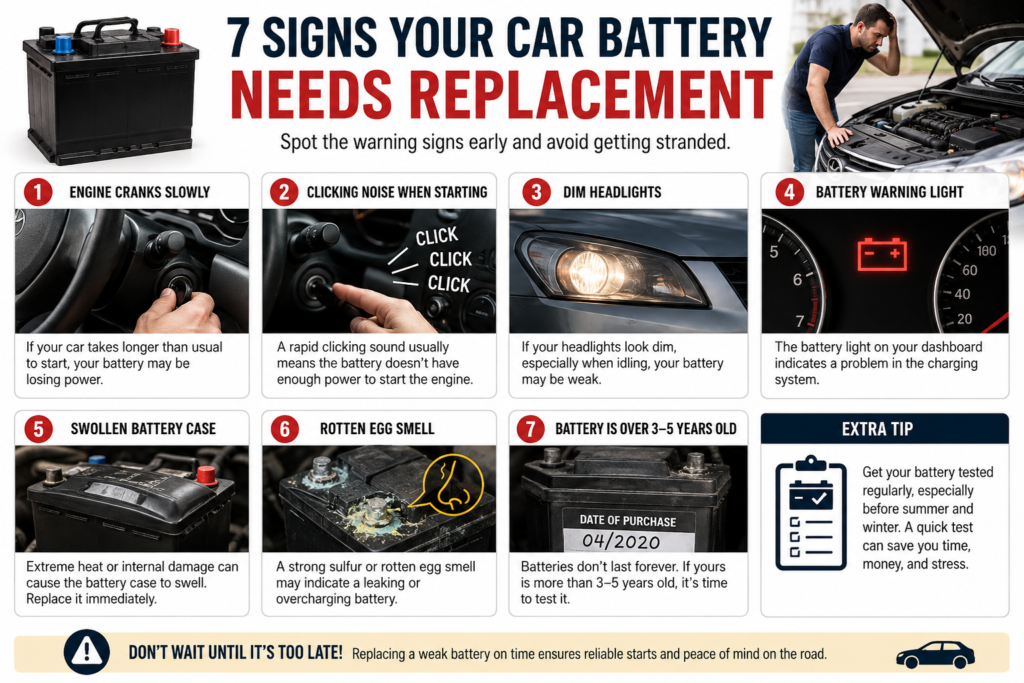
How Long Do Car Batteries Last?
Most car batteries last between three and five years, although actual lifespan depends heavily on driving habits, climate, and maintenance.
A vehicle driven daily on long highway trips generally puts less strain on the battery than a vehicle used only for short errands around town.
Several factors can shorten battery life:
- Extreme summer heat
- Freezing winter temperatures
- Frequent short trips
- Leaving lights or accessories on
- Long periods without driving
- Poor charging system performance
If your battery is approaching four years of age, it’s a good idea to start monitoring its condition more closely—even if it seems to be working normally.
1. The Engine Cranks Slowly
Car Struggles to Start in the Morning
One of the earliest signs of a failing car battery is a slow engine crank.
Instead of firing up immediately, the starter sounds weak and sluggish:
“Rrrr… rrrr… rrrr…”
The engine eventually starts, but it doesn’t sound as confident as it used to.
This happens because the battery is losing its ability to deliver enough power to the starter motor.
A Common Real-World Scenario
Imagine leaving for work on a cold morning. Your car starts, but it takes an extra second or two. The next week it takes even longer.
Many people assume it’s because of the weather and continue driving. A month later, the car won’t start at all.
Slow cranking is often the first warning sign that battery replacement may be approaching.
2. You Hear Clicking When Starting
Clicking Noise When Starting the Car
A healthy battery provides enough power to engage the starter motor instantly.
When battery voltage drops too low, you may hear:
- A single click
- Multiple rapid clicks
- Repeated clicking without engine turnover
The clicking sound occurs because there isn’t enough electrical power available to properly engage the starter.
Quick Check
If a jump-start gets the vehicle running immediately but the problem returns a few days later, the battery is likely the culprit.
While starter motor problems can also cause clicking, a weak battery remains one of the most common causes.
3. Headlights Become Dim or Flicker
Dim Headlights When Idling
Modern vehicles rely heavily on electrical power.
As batteries age, they struggle to support all the systems drawing power from them.
You may notice:
- Dim headlights
- Flickering dashboard lights
- Slow power windows
- Weak blower motor performance
- Delayed infotainment system startup
Headlights are often the easiest symptom to spot.
Simple Driveway Test
Park your vehicle at night and turn on the headlights.
If they appear noticeably brighter when you lightly press the accelerator and dim again at idle, it’s worth having the battery and charging system inspected.
4. The Battery Warning Light Appears
Most vehicles have a battery-shaped warning light on the dashboard.
Many drivers assume this light automatically means the battery is bad. That’s not always true.
The warning light simply indicates that something in the charging system isn’t operating correctly.
Possible causes include:
- Weak battery
- Failing alternator
- Loose battery cables
- Corroded terminals
- Damaged wiring
Don’t Ignore It
One of the most common mistakes drivers make is continuing to drive for weeks after seeing the warning light.
A quick battery and charging-system test can often identify the issue before it turns into a roadside emergency.
5. The Battery Case Looks Swollen
Swollen Car Battery Case
Take a quick look under the hood.
A healthy battery should have straight, flat sides.
If the battery appears bloated, swollen, or misshapen, internal damage has likely occurred.
Heat is often the biggest culprit.
During summer, temperatures under the hood can become extremely high. Excessive heat accelerates chemical breakdown inside the battery and can cause the outer case to expand.
Why This Matters
A swollen battery isn’t just worn out—it may become unsafe.
If you notice visible swelling, replacement is usually the safest option.
6. You Notice a Rotten Egg Smell
Rotten Egg Smell From the Battery
A strong sulfur smell that resembles rotten eggs should never be ignored.
This odor can indicate that the battery is leaking gas or experiencing an internal fault.
Potential causes include:
- Battery overcharging
- Internal damage
- Battery leakage
- Charging system problems
What You Should Do
If you notice this smell:
- Turn off the engine.
- Avoid touching leaking battery residue.
- Inspect the area carefully.
- Have the battery tested as soon as possible.
This is one warning sign that deserves immediate attention.
7. Your Battery Is More Than 3–5 Years Old
Age Alone Can Be a Warning Sign
Sometimes batteries fail without obvious symptoms.
That’s why age remains one of the most reliable indicators of future failure.
A battery may perform perfectly one day and fail unexpectedly the next—especially during extreme weather.
A practical guideline:
- 0–3 years: Usually healthy
- 3–4 years: Begin periodic testing
- 4–5 years: Monitor closely
- Over 5 years: Consider proactive replacement
Many professional mechanics recommend testing older batteries before long road trips or seasonal weather changes.
Common Battery Mistakes Drivers Make
Over the years, several patterns appear again and again.
Waiting Until the Battery Dies Completely
Replacing a battery on your schedule is much easier than dealing with an unexpected breakdown.
Ignoring Corrosion
White, green, or blue deposits around battery terminals can interfere with electrical flow.
Taking Only Short Trips
Short drives may not give the alternator enough time to fully recharge the battery.
Assuming a New Battery Lasts Forever
Even premium batteries eventually wear out. Regular testing becomes increasingly important as the battery ages.
When Should You Replace Your Car Battery?
Consider replacing your battery if:
- The engine cranks slowly.
- You frequently need jump-starts.
- The battery warning light stays on.
- Electrical systems seem weaker than normal.
- The battery case is swollen.
- You notice sulfur odors.
- The battery is over four or five years old.
Most repair shops and auto parts stores can test a battery in just a few minutes, making it easy to determine whether replacement is necessary.
Frequently Asked Questions
What are the signs of a dead car battery?
Common signs include slow engine cranking, clicking sounds during startup, dim headlights, dashboard warning lights, and complete failure to start.
How can I tell if my car battery is bad?
A professional battery test is the most reliable method, but recurring starting problems and weak electrical performance are strong indicators.
Can a car battery die suddenly?
Yes. However, many batteries provide warning signs beforehand, such as slower starts and reduced electrical performance.
How often should a car battery be replaced?
Most drivers replace their batteries every three to five years, depending on climate and usage.
Is a swollen battery dangerous?
Yes. A swollen battery may indicate internal damage and should be replaced promptly.
Can extreme weather affect battery life?
Absolutely. Both high heat and freezing temperatures can accelerate battery wear and increase the risk of failure.
Final Takeaway
Your car battery is one of those components that rarely gets attention until something goes wrong. Yet most battery failures provide clear warning signs long before the vehicle stops starting.
Slow cranking, clicking sounds, dim headlights, warning lights, swelling, unusual odors, and advanced battery age are all clues that replacement may be approaching.
Paying attention to these symptoms can help you avoid getting stranded and give you the opportunity to replace the battery on your terms—not in the middle of a parking lot when you’re already running late.
A five-minute battery test today could save hours of inconvenience tomorrow.
Read about Gear & Maintenance – knowabteverything
The 100k-Mile Club: The Ultimate Checklist for Cars Hitting Six Figures – knowabteverything
How to Clean Dust Out of Laptop Vents Safely Without Compressed Air – knowabteverything
How Often Should You Change Engine Oil? A Complete Guide for Every Driver – knowabteverything
15 Camping Gear Maintenance Mistakes That Cost You Money (and How to Avoid Them) – knowabteverything

About Amish
Hi, I’m Amish, and developer.
I write practical React Native, Node.js, MongoDB, and Supabase tutorials based on real projects and testing.
[…] Read about 7 Signs Your Car Battery Needs Replacement! – knowabteverything […]
[…] 7 Signs Your Car Battery Needs Replacement! – knowabteverything […]