
Which Water Purifier Is Best for Home? A Practical Guide from Budget to Premium Models (2026). Choosing a water purifier sounds simple until you start shopping. One brand promises copper-enriched water, another advertises alkaline technology, and a third claims to use seven or eight purification stages. Prices range from less than ₹3,000 to over ₹25,000.
So which water purifier is actually best for your home?
After comparing popular models and understanding how different purification technologies work, one thing becomes clear: the best purifier isn’t necessarily the most expensive one. The right choice depends on your water source, water quality, family size, and maintenance budget.
This guide will help you understand what matters, what doesn’t, and which water purifiers offer the best value at every price point.
Table of Contents
- Why Choosing the Right Water Purifier Matters
- Understanding Water Purifier Technologies
- How to Choose the Right Water Purifier
- Best Budget Water Purifiers
- Best Mid-Range Water Purifiers
- Best Premium Water Purifiers
- Budget vs Premium: Is Spending More Worth It?
- Common Mistakes Buyers Make
- Frequently Asked Questions
- Final Recommendations
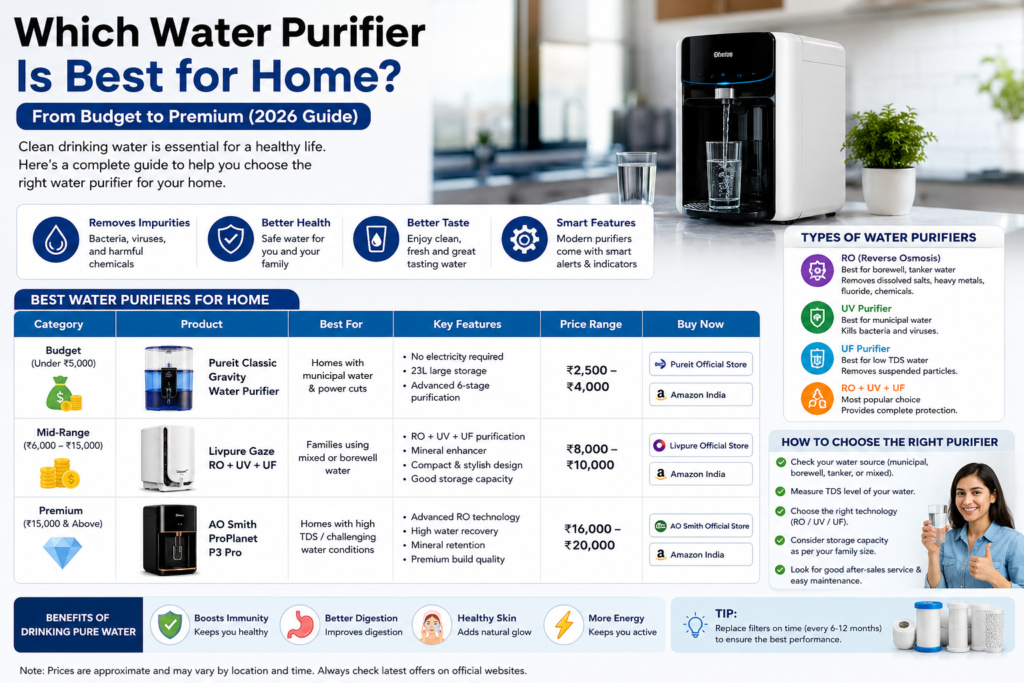
Why Choosing the Right Water Purifier Matters
Many people assume that if water looks clean, it must be safe to drink.
Unfortunately, that’s not always true.
Contaminants such as bacteria, viruses, dissolved salts, pesticides, heavy metals, and excess chlorine are often invisible. Depending on where you live, your water source may contain one or several of these impurities.
For example:
- Municipal water is usually treated but may still contain microorganisms.
- Borewell water often contains high levels of dissolved salts and minerals.
- Tanker water quality can vary significantly from one supplier to another.
A good purifier doesn’t just clean water—it improves taste, protects your family’s health, and provides peace of mind.
Understanding Water Purifier Technologies
Before looking at products, it’s important to understand what the different technologies actually do.
RO (Reverse Osmosis)
RO technology forces water through a specialized membrane that removes dissolved salts, heavy metals, fluoride, and many chemical contaminants.
Best For
- Borewell water
- Hard water
- High-TDS water
Not Always Necessary For
- Low-TDS municipal water
One common mistake is buying an RO purifier when water quality doesn’t require it. In some cases, this simply increases maintenance costs without providing additional benefits.
UV Purification
UV purifiers use ultraviolet light to destroy bacteria and viruses.
Best For
- Municipal water
- Low-TDS water supplies
Limitation
UV systems do not reduce dissolved salts or TDS levels.
UF (Ultrafiltration)
UF technology removes suspended particles and microorganisms without electricity.
Best For
- Areas with regular power cuts
- Low-TDS water
RO + UV + UF
This combination has become the standard recommendation for many Indian homes.
It combines:
- RO for dissolved impurities
- UV for microorganisms
- UF for additional filtration
If you’re unsure about your water quality, this combination is usually the safest choice.
How to Choose the Right Water Purifier
Step 1: Check Your Water Source
Your water source determines the type of purifier you need.
| Water Source | Recommended Technology |
|---|---|
| Municipal Supply | UV or UV + UF |
| Borewell Water | RO + UV + UF |
| Tanker Water | RO + UV + UF |
| Mixed Sources | RO + UV + UF |
Step 2: Measure TDS
TDS stands for Total Dissolved Solids.
A simple TDS meter costs only a few hundred rupees and can prevent an expensive purchasing mistake.
General Guidelines
- Below 300 ppm → UV or UF may be enough
- 300–600 ppm → RO recommended
- Above 600 ppm → RO with mineral retention technology strongly recommended
Step 3: Consider Long-Term Costs
Many buyers focus only on purchase price.
In reality, annual maintenance can significantly impact ownership costs.
Before buying, check:
- Filter replacement costs
- AMC availability
- Local service support
- Warranty coverage
A purifier that costs ₹2,000 less upfront may end up costing more over the next few years.
Best Budget Water Purifiers (Under ₹5,000)
These models are ideal for families looking for reliable purification without spending a fortune.
Pureit Classic Gravity Water Purifier
Why It Stands Out
This is one of the most practical options for households that experience power cuts.
Pros
- No electricity required
- Large storage capacity
- Low maintenance
- Easy to move around
Best For
Small families using municipal water.
Buy Now
Kent Gold Plus
Why It Stands Out
Kent’s gravity-based design provides dependable filtration at an affordable price.
Pros
- Electricity-free operation
- Trusted brand
- Easy filter replacement
Best For
Homes with low-TDS municipal water.
Buy Now
Aquaguard Amrit
Why It Stands Out
A simple purifier from a brand that has been serving Indian households for decades.
Pros
- Affordable entry price
- Compact design
- Good brand support
Best For
First-time buyers on a tight budget.
Buy Now
Best Mid-Range Water Purifiers (₹6,000–₹15,000)
For most households, this category offers the best balance between performance and affordability.
Livpure Gaze RO + UV + UF
Why Many Families Choose It
This model offers nearly every feature an average household needs without entering premium pricing territory.
Highlights
- Multi-stage purification
- Mineral enhancement
- Modern design
- Good value for money
Best For
Families using mixed water sources.
Buy Now
Aquaguard Sure Delight RO + UV
What Makes It Popular
Aquaguard’s service network remains one of its biggest advantages.
When filters need replacement, support is usually easy to find.
Best For
Families looking for reliable after-sales service.
Kent Grand RO
Why It Remains a Bestseller
Kent has built a strong reputation by focusing on effective purification and mineral retention.
Highlights
- RO purification
- TDS control
- Good storage capacity
- Widely available servicing
Best For
Homes using borewell or tanker water.
Best Premium Water Purifiers (₹15,000–₹30,000)
Premium models add convenience, smarter monitoring, and advanced purification systems.
AO Smith ProPlanet P3 Pro
What Makes It Premium
AO Smith focuses heavily on purification quality and build quality.
Key Features
- Advanced RO technology
- High-quality construction
- Better water recovery compared to older RO systems
Best For
Families seeking long-term reliability.
Buy Now
LG PuriCare
Why It Stands Out
LG combines water purification with a sleek modern design.
Highlights
- Smart alerts
- Attractive appearance
- Reliable purification performance
Best For
Modern kitchens and smart homes.
Buy Now
Aquaguard Aspire Halo
Why It’s Worth Considering
This model targets households dealing with challenging water conditions.
Highlights
- Multi-stage purification
- Long filter life
- Premium design
- Advanced filtration technology
Best For
Large families and areas with inconsistent water quality.
Budget vs Premium: Is Spending More Worth It?
Not always.
In fact, many households will be perfectly satisfied with a purifier in the ₹8,000–₹15,000 range.
Premium models usually offer:
- Better aesthetics
- Smart monitoring
- Longer filter life
- Advanced purification features
However, the actual drinking water quality may not differ dramatically for every household.
If your water quality is moderate and your family size is average, a good mid-range purifier often provides the best value.
Comparision Table
| Water Purifier | Best For | Price Range | Buy Link |
|---|---|---|---|
| Pureit Classic | Budget Buyers | ₹2,500–₹4,000 | Official Store |
| Kent Gold Plus | Municipal Water | ₹3,000–₹4,500 | Official Store |
| Livpure Gaze | Best Value | ₹8,000–₹10,000 | Official Store |
| Kent Grand | RO Purification | ₹10,000–₹14,000 | Official Store |
| AO Smith ProPlanet P3 Pro | Premium Homes | ₹16,000–₹20,000 | Official Store |
| LG PuriCare | Smart Features | ₹15,000–₹22,000 | Official Store |
Common Water Purifier Buying Mistakes
Over the years, appliance experts have noticed several recurring mistakes.
Buying RO Without Checking Water Quality
This is probably the most common mistake.
RO is excellent when needed but unnecessary in some situations.
Ignoring Service Availability
A purifier is only as good as the service network supporting it.
Always verify local service availability before purchasing.
Choosing Based Only on Price
The cheapest purifier may not suit your water conditions.
Likewise, the most expensive model may provide features you’ll never use.
Forgetting Maintenance Costs
Filters eventually need replacement.
Before buying, ask about annual maintenance expenses.
Frequently Asked Questions
Which water purifier is best for home use?
For most Indian households, an RO + UV + UF purifier offers the best balance of safety and versatility.
Which is better: Kent, Aquaguard, or Pureit?
All three are reputable brands.
- Kent excels in RO technology.
- Aquaguard is known for strong service support.
- Pureit offers excellent budget-friendly options.
The better choice depends on your specific requirements.
Is RO water safe for daily drinking?
Yes, modern RO systems are designed to retain or restore essential minerals while removing harmful contaminants.
How often should water purifier filters be changed?
Most filters require replacement every 6 to 12 months, depending on usage and water quality.
Can I use a UV purifier with borewell water?
Usually not.
Borewell water often contains high dissolved salts that UV technology cannot remove. In most cases, an RO-based purifier is the better option.
Final Recommendations
If you’re shopping today and want a quick recommendation:
Best Budget Choice
Pureit Classic Gravity Water Purifier
Reliable, affordable, and ideal for households using municipal water.
Best Overall Value
Livpure Gaze RO + UV + UF
Offers the strongest combination of features, performance, and affordability.
Best Premium Choice
AO Smith ProPlanet P3 Pro
Excellent purification quality, durable construction, and long-term reliability.
At the end of the day, the smartest purchase isn’t the most expensive purifier on the shelf. It’s the purifier that matches your water source, fits your budget, and can be maintained easily for years to come.
Spend a few minutes checking your water quality before buying, and you’ll make a far better decision than someone choosing based on advertisements alone.
Read about Gear & Maintenance – knowabteverything

About Amish
Hi, I’m Amish, and developer.
I write practical React Native, Node.js, MongoDB, and Supabase tutorials based on real projects and testing.
[…] Which Water Purifier Is Best for Home? A Practical Guide from Budget to Premium Models (2026) –… […]
[…] Read about Which Water Purifier Is Best for Home? A Practical Guide from Budget to Premium Models (2026) –… […]