
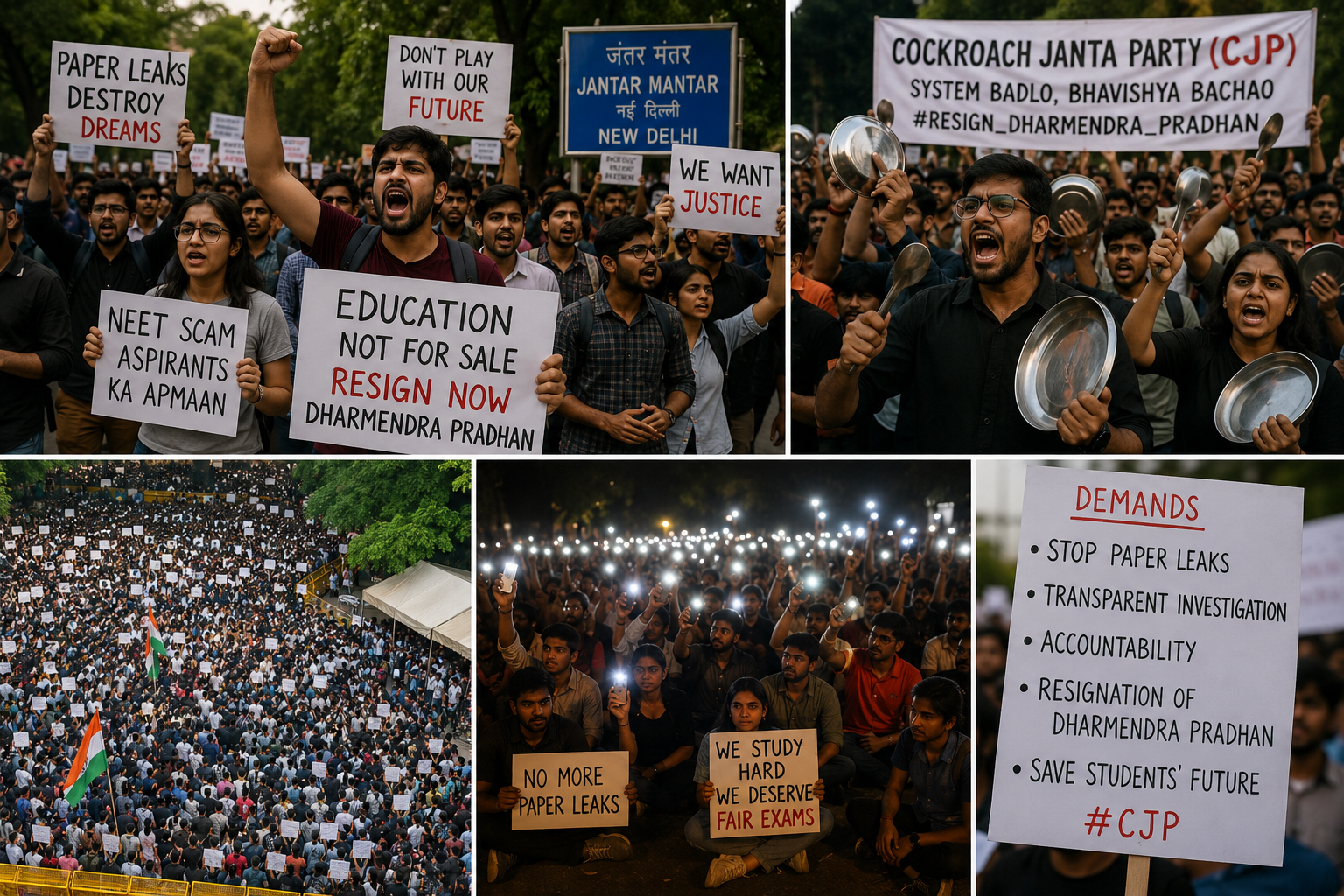
Inside the Massive Student Protest at Jantar Mantar: Thalis, Flashlights, and a Generation Running Out of Patience. Thousands gathered in Delhi on June 20 demanding accountability for exam paper leaks, education reforms, and the resignation of Education Minister Dharmendra Pradhan.
For most people, an exam is a few hours in a classroom.
For India’s students, it is often years of sacrifice.
It is the alarm clock that rings at 4 a.m., the coaching fees parents struggle to pay, the family celebrations postponed until results arrive, and the belief that hard work will eventually be rewarded.
That belief was at the heart of the massive student protest held at Delhi’s Jantar Mantar on June 20, 2026, where thousands of young people gathered under the banner of the Cockroach Janta Party (CJP) to express growing anger over recurring examination controversies and alleged paper leaks.
What began as a demonstration against exam irregularities quickly evolved into something much larger—a public expression of frustration from a generation increasingly worried about the credibility of India’s competitive examination system.
As the day unfolded, protesters raised slogans, banged steel plates and spoons, demanded political accountability, and eventually sat in the dark under the glow of mobile phone flashlights after authorities refused permission to extend the rally.
For many students present, the protest was not only about NEET-UG or any single examination.
It was about trust.
And whether that trust still exists.
Why Thousands of Students Took to the Streets
The immediate backdrop to the protest was the continuing anger surrounding examination paper leak controversies, particularly those linked to national-level entrance tests such as NEET-UG.
However, conversations with students on the ground revealed concerns that extended far beyond one examination cycle.
Many protesters argued that repeated allegations of paper leaks, administrative lapses, and delayed investigations have gradually weakened confidence in systems that determine admission to medical colleges, universities, and professional institutions.
For students preparing for highly competitive exams, the stakes are enormous.
A single attempt can determine educational opportunities, career paths, and financial futures.
Many aspirants spend two or three years preparing full-time. Families often invest significant portions of their savings into coaching institutes, study materials, accommodation, and travel expenses.
When questions emerge about the integrity of an examination, students say the damage is not limited to the test itself.
It affects confidence in the entire process.
As one protester explained while holding a handwritten placard:
“You can ask students to study harder. You cannot ask them to compete with a leaked paper.”
That sentiment resonated throughout the day.
The Central Demand: Accountability at the Highest Level
Although protesters raised a range of concerns, one demand dominated speeches, banners, and slogans.
The resignation of Union Education Minister Dharmendra Pradhan.
Student groups argued that repeated controversies surrounding national examinations require accountability from the highest levels of leadership.
Their position was straightforward: when large-scale examination failures repeatedly occur, responsibility should not stop with local officials or investigating agencies.
Whether or not the government accepts that argument, the demand became the defining political message of the demonstration.
Throughout the afternoon, chants calling for accountability echoed across Jantar Mantar, drawing attention from passersby, media crews, and supporters gathering around the protest site.
The Sound That Defined the Protest
Every major demonstration develops its own symbol.
For this protest, it was sound.
Thousands of students arrived carrying ordinary household items—steel plates and spoons.
At coordinated moments throughout the rally, protesters began striking them together.
The resulting noise was impossible to ignore.
The metallic rhythm echoed through the protest area, drowning out traffic sounds and forcing attention toward the gathering.
Students described the act as symbolic.
Many said it represented an attempt to “wake up” policymakers who they believe have failed to adequately address recurring examination controversies.
The image was powerful because of its simplicity.
No expensive campaign.
No elaborate stage production.
Just thousands of students using everyday objects to express extraordinary frustration.
Videos of the thali-and-chammach protest quickly spread across social media platforms, becoming one of the most recognizable images from the day.
Behind Every Placard Was a Personal Story
The protest’s emotional weight came not from speeches but from the people attending it.
Among the crowd were first-generation college aspirants, students preparing for medical entrance examinations, recent graduates waiting for recruitment exams, and parents who had traveled long distances to support their children.
Many carried folders containing admit cards, scorecards, and preparation notes.
Others carried photographs documenting years of study.
Several students spoke about sacrificing social lives, hobbies, and family events to focus entirely on exam preparation.
Some described taking gap years.
Others discussed the pressure of explaining repeated delays and uncertainties to relatives who expected results.
For students from middle-class and lower-income families, the financial impact is often significant.
A single examination cycle can involve coaching fees, rent, transportation costs, application charges, and study materials.
When an examination’s credibility comes into question, students say they lose more than time.
They lose confidence.
As Evening Fell, Tensions Began to Rise
The atmosphere changed noticeably after sunset.
Organizers reportedly sought permission to continue the demonstration beyond the originally approved time period.
Authorities declined the request.
Police personnel instructed participants to conclude the gathering according to existing permissions.
Many students, however, were reluctant to leave.
For those who had traveled long distances or spent the entire day protesting, ending the demonstration felt like abandoning the message they had come to deliver.
What followed became one of the most striking moments of the day.
A Sit-In Illuminated by Mobile Phone Flashlights
Instead of dispersing, groups of students sat down and continued their protest.
As darkness spread across the area, thousands switched on their mobile phone flashlights.
Within minutes, the protest site transformed into a sea of lights.
The visual carried a powerful message.
Students who felt unheard during the day were making themselves impossible to overlook at night.
Without large stages or elaborate arrangements, the gathering became quieter but more emotionally charged.
Participants shared experiences, discussed examination reforms, and continued raising slogans demanding accountability.
The flashlight sit-in quickly emerged as the defining image of the evening.
For many observers, it symbolized both determination and exhaustion—a generation refusing to give up despite feeling repeatedly let down.
Concerns Over Access to Food and Water
As the sit-in continued, participants reported difficulties obtaining food and drinking water.
Students alleged that restrictions around the protest site made it harder for supplies to reach those remaining at the gathering.
Regardless of differing interpretations regarding crowd-control measures, the situation highlighted the physical challenges faced by demonstrators who had already spent hours in the summer heat.
Student representatives argued that peaceful protesters should have uninterrupted access to basic necessities, especially during prolonged public demonstrations.
The issue added another layer of tension to an already charged atmosphere.
What This Protest Says About India’s Education Crisis
It would be easy to view the June 20 protest as a reaction to a single controversy.
That would be a mistake.
The turnout at Jantar Mantar reflected something deeper: a growing crisis of confidence among young Indians.
Students are increasingly asking difficult questions.
Can competitive examinations remain credible in the face of repeated leak allegations?
How quickly should authorities respond when irregularities emerge?
Who is ultimately accountable when trust in public examinations is damaged?
These questions are not partisan.
They concern the foundation of merit-based opportunity.
A competitive examination system works only when participants believe the process is fair.
The moment that confidence weakens, the legitimacy of outcomes begins to weaken as well.
That is why paper leak controversies generate such intense reactions.
For students, they are not administrative errors.
They are threats to years of effort.
What Students Are Asking For
Despite the political slogans and confrontations, the demands raised at Jantar Mantar remained remarkably consistent.
Students repeatedly called for:
- Stronger safeguards against paper leaks
- Faster and more transparent investigations
- Clear accountability for examination failures
- Better protection of merit-based selection systems
- Greater transparency from examination authorities
- Long-term reforms to restore public confidence
At its core, the demand is simple.
Students want assurance that success will be determined by preparation, knowledge, and hard work—not by irregularities beyond their control.
The Bigger Message From Jantar Mantar
The most memorable image from June 20 may not be the speeches, the slogans, or even the political demands.
It may be the sight of thousands of young people sitting under mobile phone flashlights after being told the protest could not continue.
It was a powerful reminder that India’s education system is not merely an administrative structure.
It shapes dreams, careers, and futures.
The students gathered at Jantar Mantar were not asking for special treatment.
They were asking for something much more fundamental:
A system they can trust.
Until that trust is rebuilt, the anger seen on Delhi’s streets is unlikely to disappear.
Read about What Is the Cockroach Janta Party? The Story Behind India’s Viral Youth Movement – knowabteverything
1 thought on “Inside the Massive Student Protest at Jantar Mantar: Thalis, Flashlights, and a Generation Running Out of Patience”