
The Best AI Translator Earbuds in 2026: Break Language Barriers in Real Time. Looking for the best AI translator earbuds in 2026? Learn how real-time translation earbuds work, their benefits, limitations, and how to choose the right device for travel, business, and everyday conversations.
A few years ago, having a conversation with someone who spoke a different language usually meant pulling out a translation app, typing awkward phrases, and hoping the translation made sense.
Today, that experience is changing fast.
Modern AI translator earbuds can listen, translate, and play back speech within seconds, making conversations feel far more natural than traditional translation tools. Whether you’re navigating a foreign city, attending an international conference, or working with clients overseas, these devices can remove much of the friction that comes with language differences.
The technology isn’t perfect—and no translation tool can fully replace a human interpreter in highly technical situations—but it has reached a point where everyday communication is remarkably smooth.
This guide explains how AI translator earbuds work, where they perform best, their limitations, and what features actually matter when choosing a device in 2026.
Table of Contents
- What Are AI Translator Earbuds?
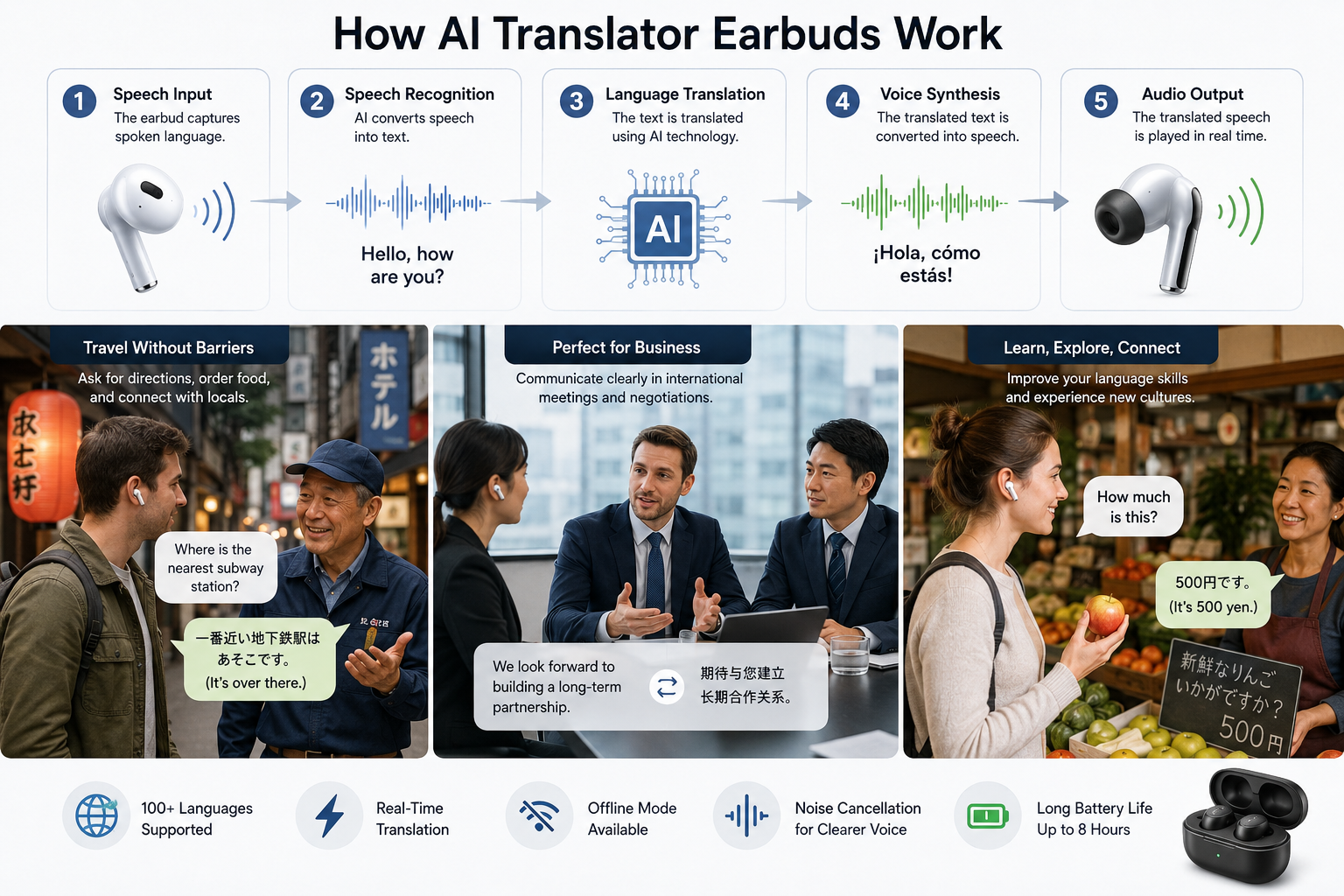
- How Do Translation Earbuds Work?
- Why Are Translator Earbuds Becoming So Popular?
- Real-World Uses for AI Translation Earbuds
- Features That Matter Most
- Translator Earbuds vs Smartphone Translation Apps
- Common Limitations to Understand
- Best Translator Earbuds for International Business Meetings
- How to Translate Live Conversations Instantly Without Internet
- Frequently Asked Questions
- Final Thoughts
What Are AI Translator Earbuds?
AI translator earbuds are wireless earbuds designed to help people communicate across different languages in real time.
They combine several technologies:
- Speech recognition
- Artificial intelligence
- Machine learning
- Natural language processing
- Voice synthesis
When one person speaks, the system identifies the language, translates the meaning, and delivers the translated speech to the listener.
The goal isn’t simply translating words. The best devices attempt to preserve context and intent so conversations feel more natural.
This is why modern translator earbuds are often described as real time simultaneous translation tools rather than simple translation gadgets.
How Do Translation Earbuds Work?
Many people hear the phrase “AI translator earbuds” and imagine something almost magical.
The reality is surprisingly straightforward.
Step 1: The Earbuds Capture Speech
When someone speaks, the earbuds or connected smartphone record the audio.
Step 2: Speech Is Converted Into Text
Advanced speech recognition software identifies spoken words and converts them into written text.
Step 3: AI Processes Meaning
This is where modern AI makes a significant difference.
Instead of translating word by word, the system analyzes context, sentence structure, and intended meaning.
For example, idioms and common expressions can often be translated more naturally than older translation systems could manage.
Step 4: The Translation Is Generated
The AI converts the sentence into the target language.
Step 5: The Listener Hears the Result
The translated message is played through the earbuds, often within just a few seconds.
The entire process creates what is commonly known as AI real time speech translation.
Why Are Translator Earbuds Becoming So Popular?
Several trends have made translation technology more useful than ever.
Remote work has increased international collaboration.
Businesses routinely communicate with customers and partners across borders.
Travel has become more accessible, and people are increasingly comfortable using AI-powered tools in everyday situations.
The result is growing demand for reliable live voice translation hardware that can work naturally during conversations.
What makes earbuds especially appealing is convenience.
Unlike traditional translation apps, you don’t have to repeatedly hand your phone back and forth or pause every few seconds to type.
The conversation keeps moving.
Real-World Uses for AI Translation Earbuds
The value of translation earbuds becomes clearer when you look at real situations.
International Travel
Imagine arriving in Tokyo and needing directions to your hotel.
Instead of pointing at a map or relying on broken phrases, you can ask a local resident a question and hear their response translated almost instantly.
Small interactions become much less stressful.
Common travel uses include:
- Asking for directions
- Ordering food
- Checking into hotels
- Shopping in local markets
- Communicating during emergencies
International Business Meetings
One of the fastest-growing applications is business communication.
A sales representative in India can discuss product requirements with a customer in Germany.
A startup founder can pitch investors from multiple countries.
A procurement team can negotiate with overseas suppliers.
The best translator earbuds for international business meetings help reduce misunderstandings and make conversations more efficient.
They don’t replace professional interpreters for legal contracts or highly technical discussions, but they can significantly improve day-to-day communication.
Education and Study Abroad
Students often use translation earbuds when:
- Attending international programs
- Participating in group projects
- Navigating a new country
- Learning a foreign language
Many learners report that hearing translated conversations in real time helps build confidence faster than relying solely on textbooks.
Features That Matter Most
Marketing pages often highlight dozens of specifications.
In practice, only a handful of features truly affect the user experience.
Translation Accuracy
Accuracy should always be your first priority.
A device supporting 100 languages is less useful than one providing highly accurate translations in the languages you actually need.
Translation Speed
Even a small delay can make conversations feel unnatural.
Look for devices known for fast response times and smooth conversational flow.
Offline Translation Support
Internet access isn’t guaranteed everywhere.
If you travel frequently, offline translation capability can be one of the most valuable features available.
Language Coverage
Consider your specific use cases.
Someone traveling through Europe may need different language support than someone working primarily with East Asian markets.
Battery Life
Translation processing uses more power than standard music playback.
A reliable device should comfortably last through a full day of meetings, travel, or sightseeing.
Noise Handling
Busy airports, train stations, and conferences can create challenges for speech recognition.
Good noise reduction often improves translation quality significantly.
Translator Earbuds vs Smartphone Translation Apps
A common question is whether dedicated translation earbuds are actually worth buying when translation apps already exist.
The answer depends on how often you’ll use them.
Smartphone Apps
Advantages:
- Lower cost
- Easy to install
- Suitable for occasional use
Disadvantages:
- Require constant phone interaction
- Interrupt conversation flow
- Less comfortable during long conversations
AI Translator Earbuds
Advantages:
- Hands-free communication
- Faster interactions
- More natural conversations
- Better suited for travel and business
Disadvantages:
- Higher upfront cost
- Some features may require internet access
For occasional vacations, a translation app may be enough.
For frequent travelers, remote workers, and international professionals, dedicated earbuds usually provide a noticeably better experience.
Common Limitations to Understand
The biggest mistake buyers make is expecting perfect translation.
No consumer device can guarantee flawless communication in every situation.
Translation quality can be affected by:
- Strong regional accents
- Technical terminology
- Background noise
- Slang and informal speech
- Poor internet connectivity
Understanding these limitations helps set realistic expectations.
The best devices excel at everyday communication—not necessarily highly specialized conversations involving medicine, engineering, or legal terminology.
Best Translator Earbuds for International Business Meetings
Business users should evaluate translation earbuds differently than casual travelers.
The most important factors include:
High Translation Accuracy
Business discussions often involve pricing, deadlines, and project requirements where misunderstandings can be costly.
Fast Response Time
Long delays can disrupt meeting flow and make conversations feel unnatural.
Strong Language Support
Companies working across multiple regions need broad language coverage.
Privacy and Security
Organizations discussing confidential information should carefully review how voice data is processed and stored.
For entrepreneurs, consultants, recruiters, sales teams, and import-export businesses, translator earbuds can quickly become a practical productivity tool.
How to Translate Live Conversations Instantly Without Internet
One of the most searched questions about translation technology is:
How can you translate live conversations instantly without internet?
While fully offline translation is more limited than cloud-based translation, many modern devices offer useful offline functionality.
Here’s the best approach:
Step 1
Choose a device that supports offline language packs.
Step 2
Download required languages before traveling.
Step 3
Install updates while connected to Wi-Fi.
Step 4
Test translations before your trip.
Step 5
Carry a charged case for extended use.
Offline translation is especially valuable during flights, train journeys, remote travel, and areas with unreliable mobile networks.
Frequently Asked Questions
Are AI translator earbuds accurate?
Most modern devices are highly accurate for everyday conversations. Performance may vary depending on language pairs, accents, speaking speed, and environmental noise.
Do translator earbuds require internet access?
Many devices use cloud-based translation services, but premium models often provide offline support for selected languages.
Can translator earbuds translate multiple languages?
Yes. Many devices support dozens of languages and regional dialects.
Are translator earbuds useful for business meetings?
Yes. They are increasingly used in international sales, customer support, networking, conferences, and cross-border collaboration.
Can translator earbuds replace human interpreters?
Not entirely. For legal proceedings, medical consultations, and highly technical discussions, professional interpreters remain the most reliable option.
Final Thoughts
Language barriers no longer have to prevent meaningful conversations.
The latest best AI translator earbuds 2026 combine advanced speech recognition, artificial intelligence, and bidirectional language translation devices technology to make communication easier than ever before.
For travelers, students, entrepreneurs, and global teams, these tools offer something more valuable than simple translation: confidence.
The ability to ask questions, build relationships, and participate in conversations without constantly worrying about language differences can transform both personal and professional experiences.
When choosing a device, focus on translation accuracy, response speed, offline support, and real-world usability rather than marketing promises alone.
The right translator earbuds won’t make you fluent overnight, but they can make the world feel a lot smaller—and far easier to navigate.